

World Review: Gaza's Crisis, Afghans Forced Home, Trade Talks Gain Momentum
This week's World Review looks at three big stories in the news

Every Friday, while “This Week with Ivo Daalder” is on summer hiatus, I will write about three major news stories and give my perspective as well as that of others. Please subscribe here and share my posts with your contacts.
Famine in Gaza
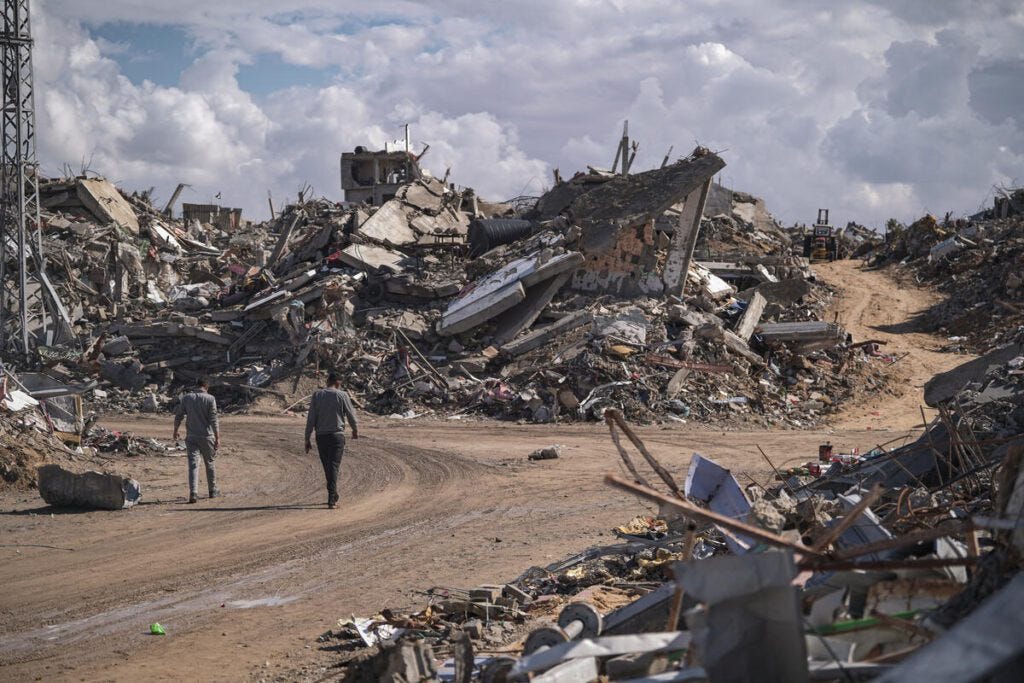
The humanitarian suffering in Gaza has long passed the point of crisis. The place is a living hell, in which a population shorn of shelter, food, water, medicine, and the very basic necessities for survival are simply unavailable. It has to stop. But it won’t stop any time soon.
Ceasefire talks have broken down, with the US and Israeli negotiators leaving Doha, blaming Hamas for failing to come to an agreement. International appeals have multiplied in recent days. Twenty-eight Western nations came together with an urgent message: “the war in Gaza must end now.” More than 100 aid agencies warned ”mass starvation is spreading across Gaza,” and described the people and their staffs there as “wasting away.” Germany, which (like the United States) had not signed the statement of western countries, joined Britain and France on Friday to declare that “the time has come to end the war in Gaza.”
None of these and other appeals will have their intended effect. Israel’s government has accepted its growing international isolation as the price it is willing to pay to achieve security at almost any cost. The government has made clear that it will not end the war until Hamas is destroyed. Hamas, for its part, will not release the hostages until and unless the war has ended. It’s a catch-22 for which the 20 or so Israeli hostages still alive and the 2 million-plus people inside Gaza are paying an unbearable price.
I only see three ways out of the dilemma. One is for the United States to join other western countries and signal the Israeli government that it needs to stop the war, flood the area with massive assistance, and encourage an international force to back a local government from beginning the reconstruction and reconstitution of Gaza. Yet, despite promising a swift end to the war and the release of hostages, the Trump Administration continues to side with the Israeli government. After the talks with Hamas broke down this week, Trump even signaled a green light for Israel to “get rid” of Hamas and “finish the job.”
A second way out would be for Israel to declare victory and stop the war. It could condition the end on Hamas releasing all hostages and agreeing to an international security presence to help maintain order after the fighting has stopped. It’s been clear for well over a year that an end to the war on these terms would have been desirable. But just because it is desirable doesn’t mean it will happen. Prime Minister Benjamin Netanyahu has long seen the continuation of the war as key to his political survival. With a foundering coalition (over issues unrelated to Gaza), this is not the time for Netanyahu to start taking political risks.
A final way out of the dilemma is unthinkable—though regrettably not unspeakable. The removal of the Palestinian population from Gaza—either by forcing them out or providing incentives for them to leave—would be another way out. Voices on the far-right have long pressed for such a move, most recently the Minister of Heritage in the Israeli government, Amichay Eliyahu, who, according to the New York Times.
said in a radio interview that “there is no nation that feeds its enemies,” adding that “the British didn’t feed the Nazis, nor did the Americans feed the Japanese, nor do the Russians feed the Ukrainians now.” He concluded that the government was “rushing toward Gaza being wiped out,” while also “driving out the population that educated its people on the ideas of ‘Mein Kampf,’” an antisemitic text written by Adolf Hitler.
Shocking though these statements are, Eliyahu is hardly the only one to express them. Indeed, President Trump encouraged the departure of Palestinians from Gaza and even proposed to taking over the territory so he could create a new Mediterranean playground for the rich and famous. While Trump hasn’t set much about it since, Netanyahu embraced Trump’s declaration as a possible new way to end the war. But if there is one thing Palestinians understand from their own history, it is that once they leave a place—forcibly or voluntarily—they’re unlikely ever to be able to come back. So, despite the extraordinary conditions Palestinians are living under, they are likely staying put. And, so, the war goes on.
More than 650 days of war have left me in deep despair. Part of it is personal. I am Jewish, the son of a holocaust survivor, and profoundly committed to Israel as a state with an unquestioned right to exist. Part of it is moral. To watch the suffering — children starving, young men shot while searching desperately for food, women unable to feed their babies, families living in inhuman conditions, sick and wounded uncared for — is simply unbearable. Part of it is analytical. What we are watching is the outcome of a strategy that, as I’ve believed and argued from the outset, could not work. Hamas couldn’t be destroyed militarily without disproportionate cost. And without an answer to who rules after the fighting stops, no strategy can work.1
While we cannot turn away from what is happening inside Gaza and we must lift our voices to do what we can do end the war, I realize that our ability to bring it to the end is not great. And that leaves me in deeper despair by the day.
Afghans Forced Back Home
For almost fifty years — since the Soviet invasion in 1979 — Afghanistan has suffered war, invasion, repression, displacement, and malaise. While most stayed in Afghanistan, over the decades many left the country — for neighboring Pakistan and Iran, and further afield. Some were lucky enough to make it to Europe or the United States. (As a student at Georgetown in 1980, I remember frequenting an Afghan restaurant with outstanding food, made and served by refugees from the Soviet invasion.)
Three new developments this week once again cast a spotlight on the plight of the people who have left or been trying to leave a country that is once again living under severe repression from an oppressive, Islamist regime that is almost completely cut off from international aid and assistance.
The first of these is the forcible ouster of more than a million Afghans from Iran—some of whom have lived in the country for more than 40 years. Following the war with Israel and the United States, Iran has turned against foreigners, notably the Afghan refugee population. Some 800,000 Afghans have been removed since March, with daily exit rates increasing from 5,000 to 30,000 in recent weeks—overwhelming Afghanistan itself and increasing the misery of a people that have already suffered so much.
While Iran has been the scene of mass deportation, the British media has been dominated by a secret effort by the UK government to bring 25,000 Afghans named in a leaked data base to the country before the leak was publicized. The data were contained in two emails inadvertently sent by a British soldier in 2022 and discovered a year later. The government applied for and obtained a legal gagging order to prevent the publication of the leak as it worked to identify the Afghans on the list and help bring them to the UK. Most of those listed have either arrived in the UK or are now en route. The gag order and cost of the operation are now subject of much inquiry, but bringing Afghans to safety is surely something Britons should welcome.
Even as the UK was trying to help those Afghans and their families that had assisted British soldiers during their deployment in Afghanistan, the Trump administration was reversing course on the US commitment to bring hundreds of thousands of Afghans that had helped US forces during the 20 years they were deployed in Afghanistan to safety in the United States. The State Department office devoted to relocating Afghans under this program was shut down as part of the department’s massive reorganization. And administration officials indicated to the Washington Post that they were not moving forward with helping hundreds of thousands of Afghans and their families to come to the United States as they had been promised.
“Wherever they end up, they end up” is the administration’s view, said one official, who spoke on the condition of anonymity to describe internal deliberations. “They are now another country’s problem.”
Trade Talks Gain Momentum
With the latest August 1 deadline for imposing “liberation day” tariffs fast approaching, some of the US’s biggest trading partners are rushing to see if they can get a deal. This week, the Philippines, Indonesia, and Japan concluded trade deals, and reports indicating the European Union was getting closer to an agreement as well. Trump has been at the center of these negotiations. The terms in many cases favor the United States, with tariff rates for foreign imports into the US set at 15 percent or more. US exports, on the other hand, generally would face fewer tariffs than they currently do. Trump and his administration view all these deals as vindication of his hard-headed negotiations and dealmaking skills.
But, and there are many buts, striking deals is one thing. Living with them is quite another. For one, the rates that are being set for imports into the United States will be at levels not seen in many decades. The result is either that prices in the US for goods that rely on imports (which almost all manufacturing in one way or another does) will up, thus fueling inflation. Alternatively, foreign exporters will look for other markets to sell their goods, creating shortages in the United States that will require years of adjustment. Neither is likely to help the American economy.
For another, the terms of the deals Trump has announced so far are often vague and in many cases contested. Even though Trump finalized a deal with Vietnam weeks ago, the details have not been published and differences in interpretation of its terms remain. Similarly, the deal Trump struck with Japan this past week is already subject of debate in Tokyo and Washington. According to the Financial Times, there is no written agreement between the two sides and there will be no legally binding agreement at all. As for a key element of the deal, Japan’s supposed commitment to invest $550 billion in US-designated projects, US and Japanese officials already disagree on its terms.
Trump said the $550bn was a “signing bonus” to the US. “What Japan did is they brought down their tariffs,” Trump told reporters. “They gave us $550bn upfront, 100 per cent. We get 90 per cent, they get 10 per cent.”
That sounds too good to be true. And it is, the FT reports.
But a slideshow issued by Japan’s Cabinet Office on Friday appeared to contradict Lutnick by saying the ratio of profit distribution would be “based on the degree of contribution and risk taken by each party”.
As for the $550 billion figure itself, Japan now says that it has committed “up to” that amount for investment in the United States.
In other words, these trade deals may not be worth the paper they are written on — or the handshake that sealed them.
I appreciate this perceptive assessment of the possible outcomes in Gaza even as I share your despair at the current reality. Every day I read the news hoping to see something, anything, that sounds like the beginnings of a path to a peaceful and just resolution. Mainly I end up crying over what I read.