

To Strike Iran, America Needs Europe
Trump has often dismissed Europe and NATO as a drain on American resources, But assembling the military forces need to strike Iran show how central Europe is to America's military power and reach

In Davos earlier this year, President Trump claimed the US had protected Europe against the Soviet Union and Russia “and gotten absolutely nothing in return.” He was wrong. That was one reason why I joined seven former US ambassadors and eight former Supreme Commanders to NATO in signing a statement outlining how NATO is vital to American security.
While the statement got a lot of attention, notably in at the security conference in Munich, I very much doubt Trump paid any attention to it. But perhaps the build up of American fire power in Europe and the Middle East provides a real-time lesson on how essential Europe is to America’s military power and reach.
Put simply, the United States cannot strike Iran with the kind of force it is assembling without access to bases and infrastructure in Europe—all of which Europeans provide and pay for as part of their commitment to NATO.
Indeed, when Trump complained in Davos that NATO is a one-way street—”we never asked for anything,” he claimed—he ignored the fact that bases in Europe are essential to his ability to engage in military action in Africa and the Middle East. The extent to which this is true was helpfully illustrated by the Financial Times in this map of US military aircraft moving from the United States in preparation for a possible strike against Iran.
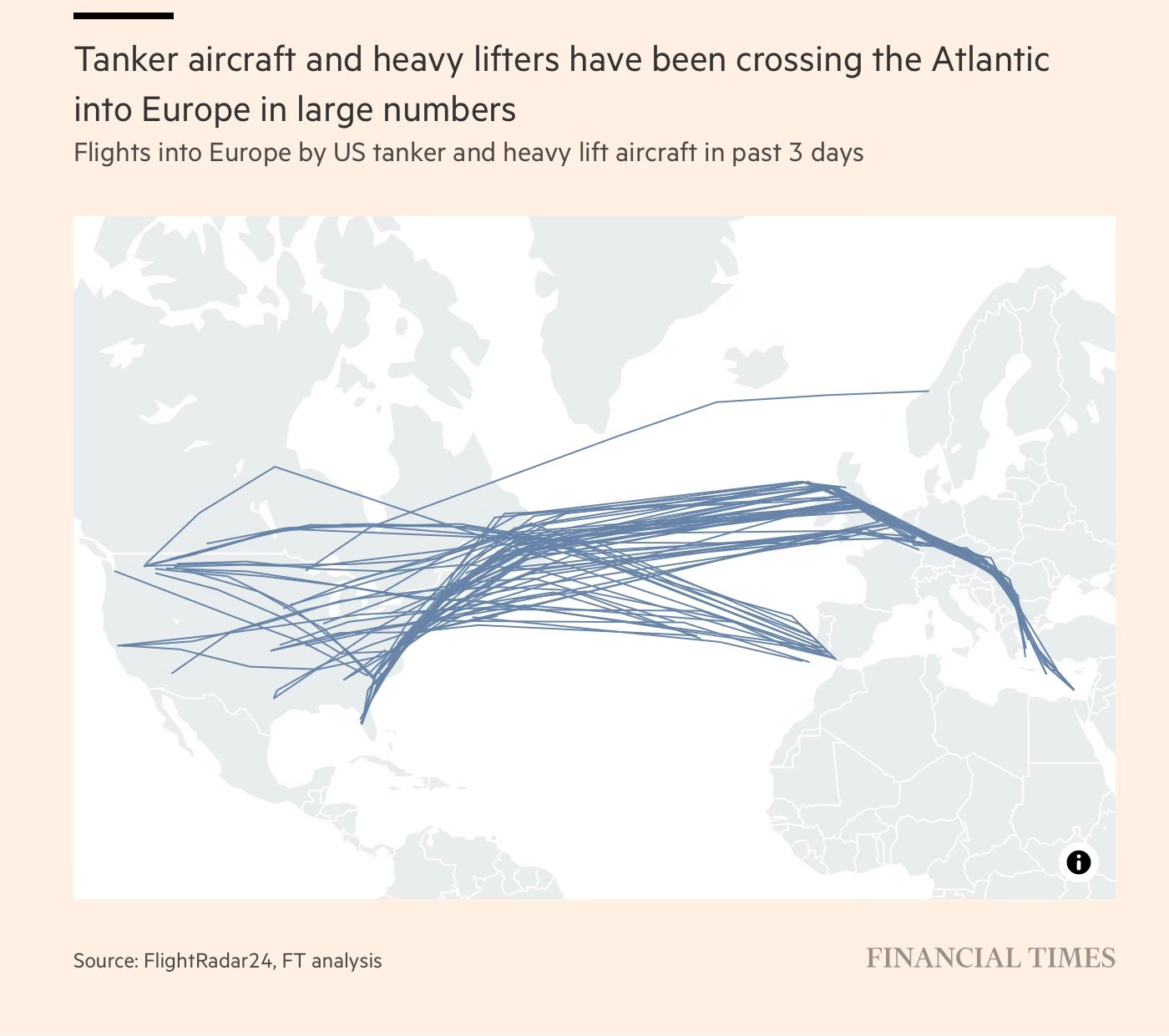
According to the FT,
Dozens of refuelling and transport aircraft have crossed the Atlantic this week. Data from Flightradar24 shows 39 airborne tankers being repositioned to locations closer to the potential theatre of action in the past three days. A further 29 heavy-lift aircraft, such as the C-17 Globemaster III, have made runs to Europe in that time.
Six journeys into Europe this month started in Fort Hood, home to the 69th Air Defence Artillery Brigade. It operates both the Patriot and Thaad systems which can defend allies and US forces against missile and aircraft attack. One C-17 delivery from Fort Hood went to Jordan.
These critical “enablers,” many of which would operate from bases in Europe, are vital to America’s ability to launch any kind of significant military strike against Iran. Indeed, when B2 bombers struck Iran last June, the entire operation over 50 refueling aircraft, with the vast majority of those supporting the Iran strike based in Europe.
One important question this time around is whether European and other governments will consent to the use of their bases and airspace for US strikes against Iran. Trump’s threats to attack Greenland and insistence that US ownership of the island is critical to its security has led many in Europe to question whether they should allow US forces to operate from their bases.
The Times reports that the UK government has informed the White House that neither Diego Garcia nor RAF Fairford, home of the US long-range bomber force in Europe, can be used to strike Iran, for example. The Saudis and Emirates have similarly led it be known that US aircraft cannot use their airspace for an attack against Iran. Others may well follow suit in denying their territory, air, and waterways to strike Iran.
There is a reason why US presidents and administrations before the current one valued alliances and allies. They are critical for America’s global military, strategic,and economic reach. Perhaps Trump will now begin to understand what allies are for and offer in return. Or, there is at least hoping that he will.
Teaching our convicted criminal a lesson that I hope he learns. He can still attack Iran, but not at all with the power he likes. However, now that Putin has a naval ship with the Iranians who knows if the felon will bow
You know, trump could just ignore any EU protestations and charge ahead, with his usual "Try and stop me" MO. If push comes to shove, he'll get his way, daring any country to get in the way of US military operations in support of an attack upon Iran.