

World Review: Tariff Man, Starvation in Gaza, Pressure on Russia
This week's World Review looks at three big stories in the news

Every Friday, while my podcast “This Week with Ivo Daalder” is on summer hiatus, I will write about three major news stories and give my perspective as well as that of others. Please subscribe here and share my posts with your contacts.
Tariff Man
Trump loves tariffs. Anyone who thought the US president was threatening to raise tariffs in order to get a deal now knows the only deal Trump is interested in is one that levies tariffs on foreign imports into the United States.
On Thursday evening, Trump signed an executive order indicating the tariff level the US would impose on each of its trading partners—ranging from a high of 50 percent on Brazil to a low of 10 percent on the UK and Falkland Islands. With a few exceptions, all these tariffs will be levied starting on August 7.
While Trump has talked about negotiating “200 deals” and his top trade advisor has promised the president would negotiate “90 deals in 90 days,” most of the tariffs are being imposed unilaterally without any deal. Even in those cases where deals were reached in recent weeks—as with Vietnam, Japan, the European Union, and United Kingdom—many details remain to be finalized or even written down. The only certain part of the deals are the tariff rates that the United States will now levy on imports from each of these trading partners, and even that is complicated by the reality that goods trade across frontiers multiple times as inputs to final production.
Aside from tariffs, Trump also trumpeted the promise of massive investments in the United States and commitments to purchase liquified national gas and other energy sources. But there is considerable uncertainty about all the these promises. The EU and South Korea promised to purchase $750 and $100 billion in LNG respectively over three years. But those are aspirational numbers that would require major changes in energy flows and might not even be feasible for US companies to meet. According to the Wall Street Journal,
“It’s a nice number but it’s just not realistic,” said Warren Patterson, head of commodities strategy at ING Bank. “You’d essentially have to divert all energy trade. That’s just not possible.”
“Even if the EU were to buy the entirety of U.S. crude and LNG exports, the annual value of its purchases would total only $141 billion,” according to research firm Gavekal. It based its figures on current prices and the U.S.’s estimated year-end LNG export capacity.
As for the massive foreign investments touted by Trump, none are set in stone. The Japanese promise of $550 billion investment is likely to consist almost entirely of loans and loan guarantees rather than new cash. While the EU promised an additional $600 billion in new investments, that figure consists of investments that were already planned by individual companies and isn’t subject to EU control. As for the claim that Europe would now spend “hundreds of billions” buying US weapons, that goal reflects the boost in European defense spending and isn’t in any way enforceable.
With little written down and much uncertain, Trump’s trade “deals” are nothing like the detailed agreements that have governed international trade the past 80 years. And because the terms are uncertain, the chance of misunderstanding and disappointment are high. Take, for example, the Korean commitment to invest in the United States. Trump claimed on Truth Social:
The Deal is that South Korea will give to the United States $350 Billion Dollars for Investments owned and controlled by the United States, and selected by myself, as President.
None of these claims will come to fruition. Korea is unlikely to invest $350 billion in one swoop. It certainly won't “give" that sum to the United States or invest in entities “owned and controlled by the United States.” And there is no way any country would allow a foreign leader to select the investment. It’s all hyperbole and balderdash. But if Trump thinks it’s real, he will be disappointed—and may well respond by slapping on additional tariffs. Just ask Brazil or Canada when it comes to dealing with an angry Trump.
So when European and other allied leaders claim that these deals bring a measure of stability and avoid upsetting relations with a volatile president, which is their best argument for selling a deeply flawed and unequal agreement back home, they should be aware that Trump bathes in uncertainty and loves to keep people guessing. This game he plays is far from over. Just ask anyone who ever invested with him in the past.
The reality is that Trump’s deals are means to an end, not an end in themselves. He is above all a Tariff Man, as I’ve argued before. He likes tariffs to increase revenue, incentivize business to built at home, and as means to punish countries and leaders with whom he has a beef. And what he wants most is to upend the postwar trading order. “This is a new system of trade,” one top adviser told the Financial Times. “We’re moving from a system where the core principle was kind of efficiency at all costs . . . to one where the core principle is fair and balanced trade.”
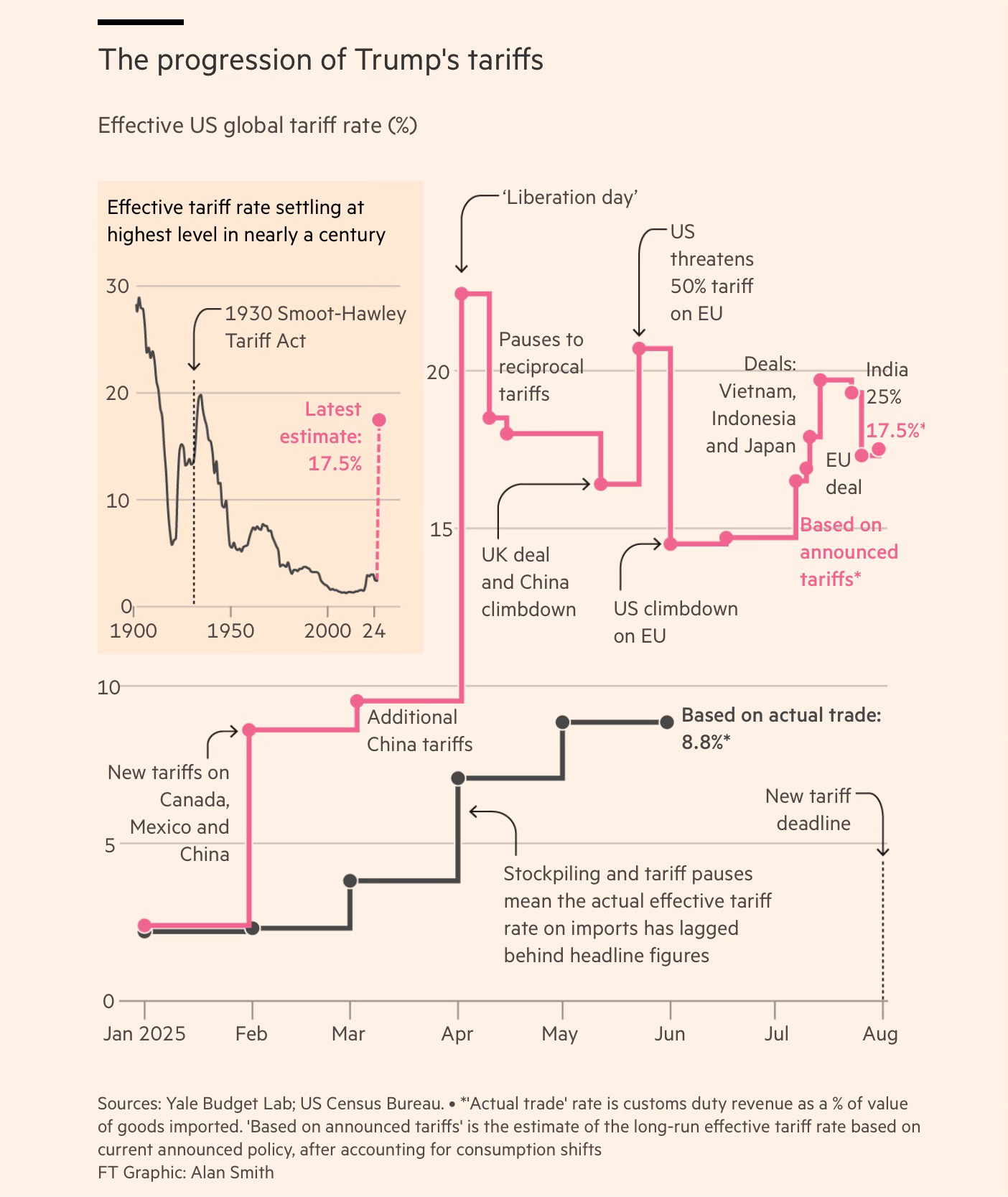
Except that this system is as “fair and balanced” for trade as Fox News is “fair and balanced” for news. The effective rate of tariffs, according to the FT, is now approaching Smoot-Hawley levels—hardly a great time for the US and world economy.
Most of America’s trading partners have no interest in returning the trading system of the 1930s. They liked and prospered under the free and fair trading system that the United States helped create and long championed. They’re willing to settle for deals because the alternatives are worse. No one wants a race to the bottom. But they’re most interested in preserving what worked previously, and for that they will seek to reduce their dependence on the US market as rapidly as possible and instead strengthen the rules and deepen trade amongst themselves. The end result will be to leave America much worse off.
Starvation in Gaza
At the start of the week, President Trump was still in denial about what was happening in Gaza — a historic, man-made famine, that was leading to an increasing number of people, especially children, dying from starvation. Instead, as the New York Times recounted, he blamed Hamas, claimed the US was the only one to deliver aid, and whined about not receiving a thank you.
As he traveled to Scotland on Friday, Mr. Trump deflected repeated questions about the hunger crisis in Gaza by insisting that food was being delivered by the United States and Israel, but was being blocked by Hamas.
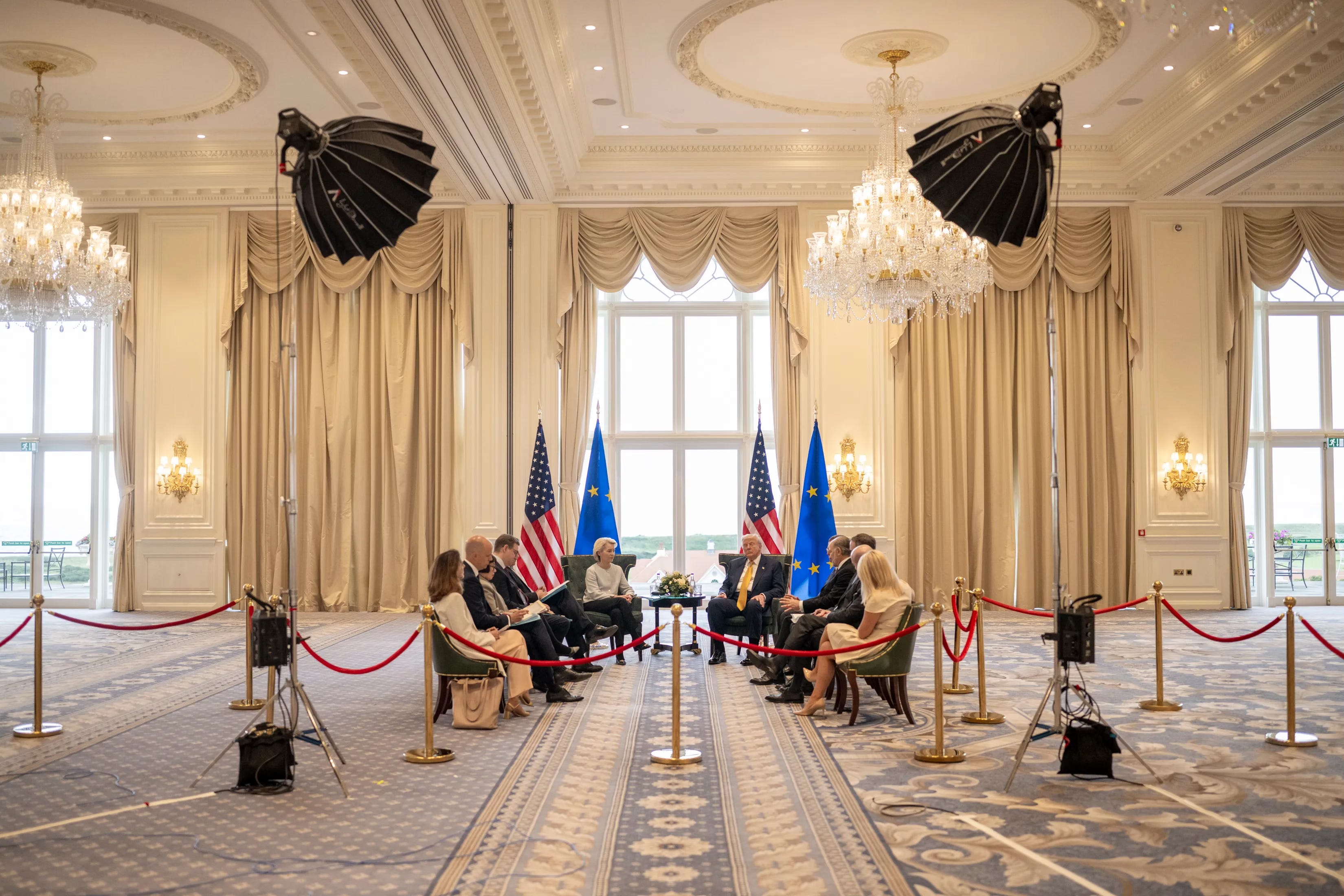
Meeting on Sunday with Ms. von der Leyen, Mr. Trump declared that suffering in Gaza was “not a U.S. problem, it’s an international problem.” He then lamented that he had not been properly thanked for the tens of millions the United States had dedicated toward helping Gaza.
Just days ago, the Trump administration said it had approved $30 million in funding for a fledgling aid distribution system in Gaza backed by Israel and run mostly by American contractors, which has seen deadly violence erupt near its distribution sites.
“Nobody acknowledged it. Nobody talks about it,” Mr. Trump said, adding: “And it makes you feel a little bad when you do that. And you know, you have other countries not giving anything.”
He added, “It would be nice to have at least a thank you.”
Mr. Trump has also claimed that “no other nation gave money.” In fact, as of January, the European Union had spent about $605 million on aid to Gaza since 2023, according to the European Commission.
By Monday, though, after having spoken with Prime Minister Starmer, Trump changed his tune. He agreed children “look very hungry” and that “we have to get the kids fed.” And he noted that he did not “particularly” agree with claims by Israel that there was no starvation in Gaza.
While Trump wasn’t willing to follow France, Britain, and Canada in moving towards recognizing a Palestinian state, he did send his special envoy to Israel to talk about getting more aid into Gaza. Ultimately, however, neither European moves nor sending envoys to visit Gaza to see for themselves is going to matter much—unless and until the war ends, security can be restored, and aid begins to flow in the massive quantities that are needed. As I wrote last week, none of that appears to be in the cards.
Pressure on Russia
Over the past few weeks we have witnessed a slow but steady evolution in Donald Trump’s view of Vladimir Putin—the man he long praised as a “strong leader” and called “smart,” “savvy,” and “a genius” for invading Ukraine. As we enter the seventh month of Trump’s return to the presidency, his views on Russia have hardened considerably.
On Monday, Trump indicated that he would shorten the deadline for Russia to agree to a ceasefire to “10-12 days.” On Thursday, he said it was “disgusting” what Russia was doing in Ukraine and said that he would “put sanctions” on Russia by August 8 if no ceasefire had been reached. He also announced that Steve Witkoff, his peace envoy, would once again travel to Moscow in a last-ditch effort to end the war. And on Friday, Trump announced he had “ordered two nuclear submarines” to be repositioned after complaining of online “provocations” by former Russian president Dmitry Medvedev, who has become an acerbic online attack dog in recent years.
Trump’s turn around on Russia appears genuine, even if his previous embrace of Putin was as well. But it is way too early to conclude Trump now accepts the analysis of most western leaders—that Russia represents a genuine threat to security and needs to be stopped in Ukraine before it is too late. Yes, weapons have started to flow to Ukraine, with Germany announcing on Thursday that the first Patriot launchers were being sent to Ukraine after securing an agreement with the United States to be first in line for new systems coming of the US production line. And he may well place new sanctions on Russia, though he admits that he didn’t “know if that has any effect, but we’re going to do it.”
At the same time, the administration has taken a slew of steps to weaken sanctions overall and done little to beef up enforcement or increase the pressure. As the Wall Street Journal reported,
When Biden officials, including the head of the State Department’s Office of Sanctions Coordination, left in January, they weren’t replaced. The term of the acting head of the office, David Gamble, ended in June. The Trump administration hasn’t named a nominee to replace him.
The EU’s sanctions coordinator, David O’Sullivan, told the bloc’s foreign ministers in June that enforcement coordination and advocacy work with the U.S. had stopped in January.
When the EU started discussing lowering the oil price cap in May as part of a new package of sanctions, officials told member states that Washington was unlikely to participate.
The sanctions—which included blacklisting two Chinese banks for facilitating trade with Russia, a ban on attempts to revive the Nord Stream pipeline and new banking sanctions—saw the EU and the U.K. lower the price cap by 15% to $47.60 per barrel.
European officials say Japan and Canada are considering joining the effort, which would leave the U.S. as the only G-7 country opting out. Without Washington’s participation, Russia can escape sanctions pressure—and keep pounding Ukraine.
Talk is easy. When it comes to Russia, only actions count.
That’s it for this week. A programming note: I will be away next week and will skip a week posting World Review.
Hopefully the courts will weigh in on the illegality of many trump tariffs.