

World Review: Russia Strikes Poland, Israel Strike Qatar, Trump Shakes Down Japan
This week's World Review looks at three big stories in the news

Every Friday, while my podcast “This Week with Ivo Daalder” is on hiatus, I will write about three major news stories and give my perspective as well as that of others. This week (two days late) I take a look at three stories that dominated the news: the drone attack on Poland, Israel’s attempt to kill Hamas leaders in Qatar, and the details on the US-Japan trade deal
Please subscribe here and share my posts with your contacts.
Russian drones target Poland
Early Wednesday morning, alarm bells rang in the Polish Operational Command indicating something was amiss. A number of drones flying over Belarus were heading to the border of Poland. Polish and Dutch planes scrambled to intercept them, an Italian early warning plane provided surveillance and targeting information, and German air defenses in eastern Poland went on high alert.
In the end, 19 drones crossed the border into Poland. At least four were shut down when they were heading to an airbase; others were tracked to make sure they did no damage. No one was insured, and damage was minimal.
Nevertheless, the Russian attack represents a major escalation of its war with Ukraine and the West. There is no doubt that the unarmed drones were sent intentionally into NATO airspace. One or two errant vehicles can be a mistake; nearly 20 demonstrates intent. Russia’s goal was to test NATO — both militarily and politically. What it discovered — a weak response and divided assessment among NATO countries — surely made the risk worthwhile.
Much has been said already about the episode, so let me confine my remarks to three points.
Where was the US?
The US response to the first intentional penetration of NATO airspace by Russian military systems — and the first time that NATO military forces were forced to shoot at a Russian system flying over NATO territory — proved deeply disconcerting. Repeated requests of the White House, State, and Defense Departments to comment on the attacks were met by silence. It took 12 hours for President Trump to post his first reaction: “What’s with Russia violating Poland’s airspace with drones? Here we go!”
No one could explain what the President meant. His next statement was even more worrying. “Could have been a mistake. Could have been a mistake,” Trump told reporters. “But regardless, I’m not happy about anything having to do with that whole situation. But hopefully it’s going to come to an end.”
While Poland was quick to contradict the American president — “No, it wasn’t a mistake,” its Foreign Minister Radek Sikorski noted — the damage was done. The White House wasn’t interested, either in condemning the Russian action or affirming its commitment to NATO’s defense. (It did not go unnoticed that no senior US official — not the president, not the secretaries of state or defense — echoed the statement by US Ambassador to NATO Matthew Whittaker that the US remained committed “to defend every inch of NATO territory.”)
As Reuters reported,
the view in Europe of Trump’s handling of the incident has ranged from dismay to confusion and unease, according to multiple diplomatic sources who spoke on condition of anonymity.
A senior German official said the U.S. had been involved in drone discussions with NATO allies but appeared to be “hesitant.” “With this U.S. administration, we can’t rely on anything. But we have to pretend that we could,” the official said.
An Eastern European diplomat said: “No one in NATO has been particularly reassured by the U.S. at this point. Washington’s silence has been almost deafening."
An Italian official, whose country’s AWACS surveillance planes helped detect the drones over Poland, said alliance members had a mostly negative impression of the U.S. response so far but they were avoiding open criticism.
How did NATO do?
Though concern that the Russian attack had exposed deep political divisions within the Alliance were both real and justified, worries that NATO had failed to defend its territory against the attack were overblown. The threat was dealt with effectively, with minimal damage and no casualties.
Even so, commentators pointed to the fact that NATO’s interception rate was around 25 percent, while Ukraine generally succeeds in taking down 80-90 percent of the much larger attacks directed at its country. But the two situations are different. First, NATO has more sophisticated surveillance capabilities, so it can concentrate limited fire at the biggest threats and leave weapons that are unlikely to do much damage alone—much like Israel does to preserve its Iron Dome missiles. Second, the Russian attacks on Ukraine are generally aimed at its cities and mostly armed, making it more important to shoot down as many of the incoming systems as possible.
NATO is now preparing for additional, perhaps larger scale, attacks by launching a new operation, “Eastern Sentry.” Additional aircraft from Denmark, France, and Germany will be deployed east to defend the entire eastern flank against drone and other air incursions, thus boosting NATO’s overall defense and deterrence capabilities. In short, NATO did well in its initial response and is stepping up its defenses.
The Need to Send a Message
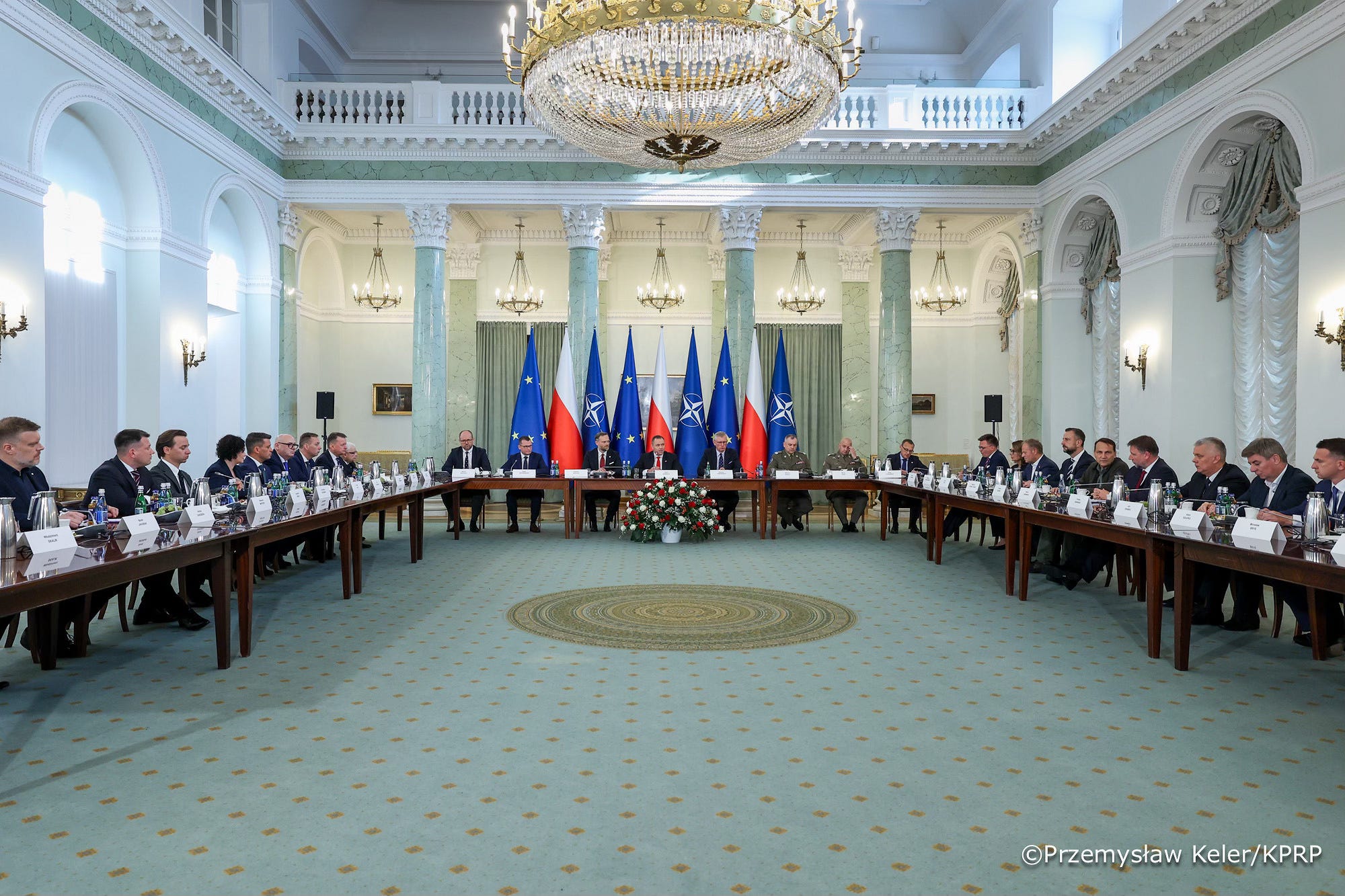
As soon as the last drone had been neutralized, Poland informed NATO that it would be invoking Article 4 of the Treaty, requesting consultations with allies on a threat to its political independence and sovereignty, which the drone attack patently was. The meeting took place Wednesday morning to underscore NATO’s unity and the need to beef up defenses. The announcement of Eastern Sentry two days later was a rapid acknowledgment of that agreement.
But is this response enough? I am not so sure. The drone attacks are but the latest in a long line of Russian efforts to use unconventional means to destabilize Europe—through assassinations, cyber attacks, blowing up ammunition depots, cutting communication cables, surveilling military installations, and more. Russia has engaged in forms of warfare against Europe and NATO that fall just short of an outright armed attack. The 19 drones sent across the Polish border similarly were unarmed and the attack thus fell short of triggering Article 5’s collective defense commitments.
So far, NATO has responded by beefing up defense, condemning unacceptable behavior, and calling in Russian ambassadors for a diplomatic scolding. What it hasn’t done is actually respond directly. The drone attacks now provide it with the excuse — and the need — to do so.
For years, Ukraine has asked NATO countries to help defend its skies against air attack — whether from missiles, by drones, or with planes. NATO has responded by sending air defense systems, training and equipping the Ukrainian Air Force with combat airplanes, and providing intelligence to help Ukraine defend itself against Russian strikes.
But NATO can and should do more. Now that the air threat has reached NATO territory, it is reasonable for NATO to defend its territory forward — defending against drones, missiles, and other air threats that could reach its territory as far forward as possible. In principle, such forward defense could be done with systems flying inside NATO airspace or deployed on NATO territory, even if their defensive reach would be well inside Ukraine’s airspace and thus help Ukraine defend itself against attacks that can be neutralized from NATO territory. NATO could also indicate that further attacks on NATO would leave it no choice but to defend even further forward, with at least combat aircraft operating within Ukraine’s airspace.
Russia’s provocation was both real and cannot stand. NATO has acted swiftly to neutralize the threat and rally its members to beefing up its defenses on the Eastern flank. But more can and should be done — including efforts to defend NATO’s territory forward by intercepting and neutralizing air threats over Ukraine that could possibly reach NATO itself.
Israel Attacks Qatar
For the second time in two months the tiny nation of Qatar, home to the largest US airbase in the Middle East, has been subject to missile attack. First it was Iran that retaliated against Israeli and US strikes against its nuclear facility. Then this week, Israeli planes launched long-range missiles to try and kill the top Hamas leadership that had gathered in the country to consider the latest US proposal to end the war in Gaza.
The latest attack came as a surprise. Yes, Israel had vowed to bring all those responsible for the October 7 massacres to justice. But attacking Hamas leaders as they were considering the latest peace proposal was daring. Doing so against a country that had served as a useful conduit and mediator between Israel and Hamas for more than a decade was questionable, to say the least. Which is why David Barnea, the head of Mossad who had led negotiations mediated by Egypt and Hamas for two years, opposed the strikes and nixed an earlier plan for using Mossad agents on the ground to kill the Hamas leaders.
In the end, the air strikes failed. None of the major leaders were killed, though some family members and lower level officials were. Trump was reportedly livid, calling Prime Minister Netanyahu soon after to tell him he felt blindsided and thought the strikes were neither in Israel’s nor America’s interests. Netanyahu seemed non-plussed. A day later he made clear that Israel would strike again. “I say to Qatar and all nations who harbor terrorists, you either expel them or you bring them to justice. Because if you don’t, we will.”
While Trump may have been angry, Netanyahu has yet to pay a price. Days after his phone call with Trump, the Israeli Prime Minister welcomed Secretary of State Marco Rubio for a visit at the Western Wall. Rubio made clear that nothing had changed.
Rubio told reporters before leaving for Israel that Donald Trump was “not happy” with the brazen Israeli strike on Doha, but added that US-Israel ties would “remain strong”.
“What’s happened has happened. Obviously we’re not happy about it . . . now we need to move forward and figure out what comes next,” Rubio said at Joint Base Andrews in Maryland on Saturday.
He added that “it’s not going to change the nature of our relationship with the Israelis”.
The Shake-Down Presidency
Diplomacy used to be about finding compromises between two countries to overcome their differences. But that was before the Donald Trump inaugurated “the shake-down presidency.” The latest, glaring example of a one-sided deal was announced earlier this month following the conclusion of US-Japan negotiations on trade and investment decisions. The details of the deal, which includes a commitment by Japan to invest $550 billion in the United States, are astonishing. As the New York Times reported:
The details that were laid out in the memorandum of understanding, which was published in the Japanese news media, underscore how Japan had to capitulate or risk damaging its economy.
Among the notable provisions of the memorandum is a clause stipulating that Mr. Trump will select Japan’s investments. Once a choice is made, Japan will review and fund the investment within 45 days, according to the document. If Japan chooses not to move ahead, Mr. Trump may impose tariffs at a higher rate of his choosing, the document stated.
Japan would initially receive half of the cash flow generated by the investment until an agreed-upon threshold was reached. After that, Japan would receive 10 percent of the cash flow. The rest of the money would go to the United States.
Little wonder that a few days later, Japan’s beleaguered Prime Minister, Shigeru Ishiba, announced he would step down. But whether a new leader will agree to abide by such a humiliating, one-sided deal, is of course an entirely different matter.
Didn't Russia strike Romania as well?
Didn't Russia strike Romania as well?