

World Review: Russia Sanctions, Palestinian Recognition, US Goes AWOL at UN
This week's World Review looks at three big stories in the news

Every Friday, while my podcast “This Week with Ivo Daalder” is on hiatus, I will write about three major news stories and give my perspective as well as that of others. This week I take a look at three stories that dominated the news: the effort to increase pressure on Russia, Israel’s response to Palestinian recognition, and the consequences of the US going AWOL at the UN.
Please subscribe here and share my posts with your contacts.
Upping the Pressure on Russia—Or Not
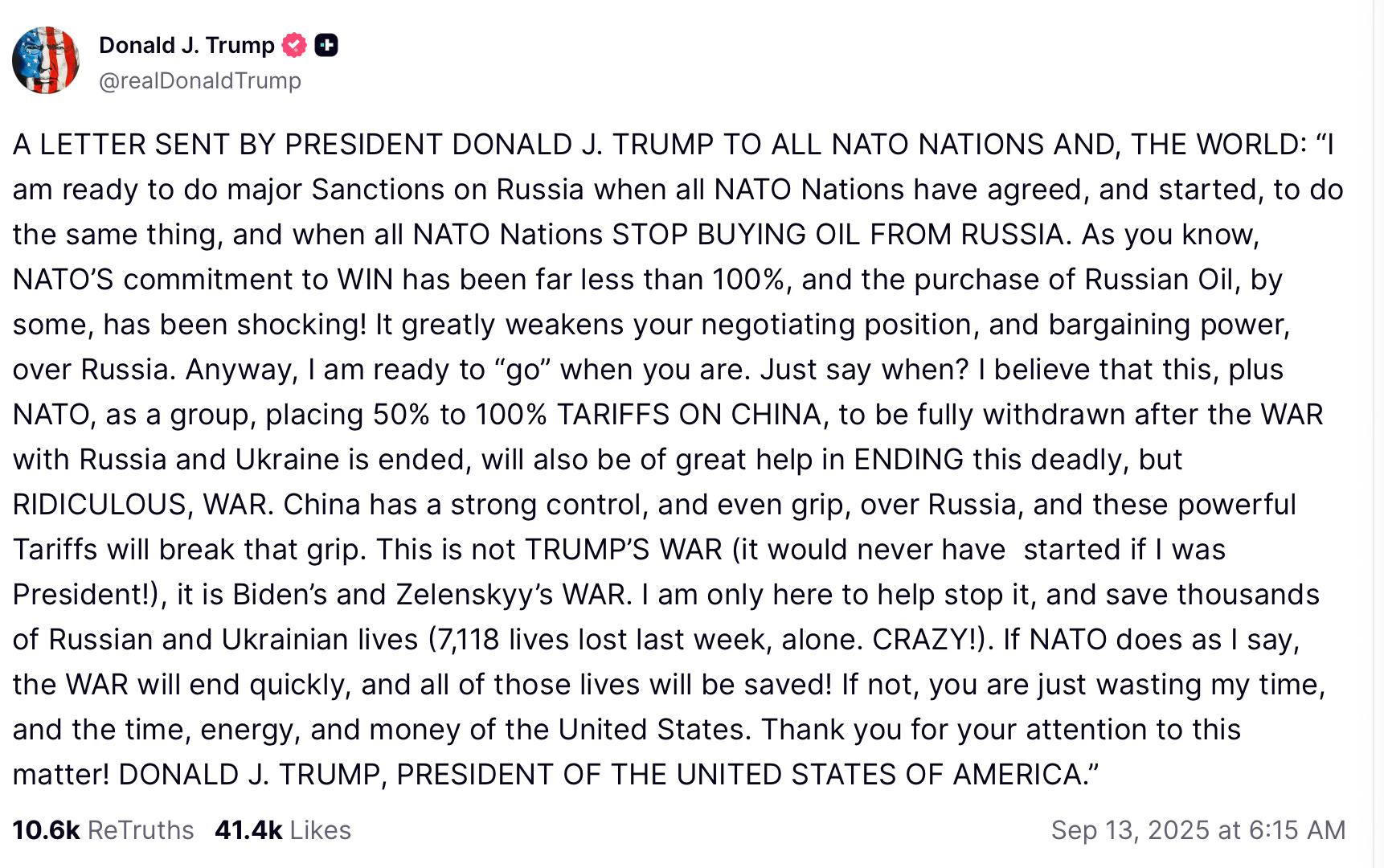
Two weeks ago, on September 5, President Trump’s latest “two weeks” deadline for Russia to end the war with Ukraine came and went. Last Sunday, Trump posted a letter to NATO allies laying out his conditions for imposing sanctions on Russia.
Today, Europe responded by publishing its 19th sanctions package—the second major package introduced by the European Union since Trump returned to office. It proposes to accelerate the date Europe will cease purchasing Russian gas by a year, reduce the price cap on Russian oil shipments from $60 to $47.60 a barrel, and “targets refineries, oil traders, petrochemical companies in third countries, including China,” European Commission President Ursula von der Leyen announced. Some 12 Chinese and three Indian firms are also targeted for new sanctions.
These are the kind actions that will hurt and put further pressure on Russia. Richard Moore, head of Britain’s MI6, suggested that continued pressure would ultimately force President Putin to make “a choice of either making a deal to end the fighting or risk an economic and political crisis that threatens his rule.“
But don’t bet on Trump joining in on the pressure campaign. Despite repeatedly threatening to impose tariffs, sanctions, and other “severe consequences” going back as far as early February, the US President has treated Putin and Russia with kid gloves. Russia was the only country to escape tariffs on Liberation day. No new sanctions have been imposed on Russia since Trump returned to office. And his administration has dismissed officials charged with sanctions enforcement and dismantled agencies responsible for developing ideas to pressure Russia and combat disinformation.
Trump’s latest effort to put the ball in Europe’s court—“I’m willing to do other things, but not when the people that I’m fighting for are buying oil from Russia,” he said in England yesterday—is just another way to avoid having to actually do something. For one, the NATO countries buying Russian oil are mainly those who oppose pressuring Russia—Hungary, Slovakia, and Turkey. Those three countries also happen to be led by leaders close to Trump, but so far he has done little to convince them to end their dependence on Russian oil. Moreover, given that the US is deeply engaged in negotiating a trade deal with China—including a second call between the two leaders today and a meeting in Seoul next month—it’s hard to see how Trump would follow through on his tariff threats if, somehow, NATO countries were to do what he asked them to do.
Europe will do what it needs to do—including providing military and economic aid to Ukraine and continuing to pressure Russia. Just don’t count on Trump joining them—in two weeks or ever.
Recognizing Palestine and Israel’s Response
This coming Monday, France and Saudi Arabia will host leaders from around the world to promote the recognition of Palestine as a state. They will be joined by key US allies from around the world, all of whom will move towers recognition of Palestinian statehood. If German Chancellor Friedrich Merz will attend, though Germany is not yet prepared to join Australia, Britain, Canada, France, and others in recognizing Palestine as a state. The European Union, meanwhile, is considering trade and other punitive measures to underscore its displeasure with Israeli policy.
Far from reconsidering the path it has chosen, Israel has chosen to double down. On Tuesday, it commenced the long-planned incursion of Gaza City. “Gaza is burning,” Israeli Defense Minister Israel Katz proclaimed. It’s an apt description. But it raises profound questions about Israel’s methods of warfare and its true aims. For the Gaza that is burning is also home to more than two million Palestinians, including half who lived in Gaza City prior to the war. If Gaza is burning—if the homes, businesses, hospitals, schools, mosques are burning—then there is nothing left for people to live in. And that, it is increasingly clear, is the point.
"Gaza will be entirely destroyed,” said Israel's far-right Minister of Finance Bezalel Smotrich back in May. “Civilians will be sent to... the south to a humanitarian zone without Hamas or terrorism, and from there they will start to leave in great numbers to third countries.” Every action Israel has taken since in then in Gaza points to the goal Smotrich outlined then.
But Gaza isn’t the only theater of war for Israel. The government seems to be determined to respond to Europeans and others moving to recognize a Palestinian state by making its establishment—at least in the territories that where Palestinians have long lived. That includes the West Bank, as a detailed examination of recent steps to control the area in the Financial Times underscores. The latest and most important step taken by the government was the approval to annex the crucial E1 area east of Jerusalem that would effectively cut the Palestinian population in the West Bank in two. As Phil Gordon, Middle East coordinator under President Obama and Vice President Harris’s national security advisor, writes in the New York Times,
In announcing the plans to move forward with E1, Finance Minister Bezalel Smotrich said the quiet part out loud, stating the settlement “buries the idea of a Palestinian state.” That notion was echoed last week by Mr. Netanyahu, who, while signing an agreement to press ahead with E1, said: “We are going to fulfill our promise that there will be no Palestinian state. This place belongs to us.” At a news conference in Jerusalem on Sept. 3, Mr. Smotrich presented a plan to formally annex roughly 82 percent of the West Bank, which would isolate Palestinians into small enclaves while Israel unilaterally took formal ownership of the rest.
Far from resisting this effort to incorporate the occupied territories into Israel proper, the Trump administration has turned a blind eye—and at times even encouraged the Israelis to move ahead. Before taking off for a flight to Israel last Saturday, Secretary of State Marco Rubio was asked whether he would ask Israel to hold off on its offensive into Gaza City,. “We’re not talking about that or anything of that nature. I mean, that certainly won’t be what I’m going to communicate,” Mr. Rubio said. “We just want to know what comes next.” And on Tuesday, when Trump was asked whether he supported the offensive, the president said “Well I have to see — I don’t know too much about it.”
The US acquiescence of Israel’s takeover of the occupied territories has given Prime Minister Netanyahu a blank check. Trump, the Wall Street Journal reported, may be quietly fuming. But outwardly he is giving Israel a pass—whether it is bombing Iran, attacking Hamas leaders in Qatar, launching an indiscriminate offensive against a city in Gaza, or laying conditions for the annexation of the West.
The US goes AWOL at the UN
President Trump will travel to New York next week to address the UN General Assembly. But the United Nations he will be addressing is increasingly a very different place than it has been before. For decades, the US as the largest contributor called many of the tunes at the United Nations. No more. Trump withdrew from the Human Rights Counci, the World Health Organization, and UNESCO. He cut the US contribution by $1 billion and has suggested additional cuts in his budget proposals for next year.
The result is that other players—notably China—are increasingly dominating the agenda and calling the shots. In Geneva, at the Human Rights Council, China, Cuba, Venezuela, and others who have long been subject of the Council’s investigations have successfully dialed back its work. China has increasingly positioned itself as the defender of the multilateral system, further isolating the United States. As the New York Times reported,
Chinese officials have long denounced multilateral efforts on labor rights, minority rights and other areas as an excuse for meddling in countries’ affairs. They are seizing the opportunity to diminish that work. At meetings in Geneva, the center of U.N. human rights work, China has joined with Cuba, Iran, Russia and Venezuela to propose saving money by scaling back human rights inquiries, a New York Times investigation found.
Chinese officials have argued that while Washington is pulling back, Beijing is upholding global values. On Sept. 12, a Chinese former U.N. official wrote in China Daily, a state-run newspaper, that with the “doubts and challenges facing the U.N., it is notable that China has been a steadfast supporter of the U.N.’s global governance endeavors, standing firm in shaping solutions to global challenges.”
Even the UN Secretary General has taken note of the shifting balance of power. While Antonio Guterres has yet to meet the US president since Trump returned to power, he did travel to Beijing last month to attend the large gathering of leaders who felt shut out by the United States.
Many Americans, not least on the right, dismiss the United Nations as an expensive talking shop that is both anti-western and anti-Israel. But much of the rest of the world still takes the organization seriously—and Washington’s growing disdain of the UN is increasingly isolating it from the institution.