

World Review: Iran Sanctions, Africa Trade, and US Invasion of Venezuela
This week's World Review looks at three big stories in the news

Every Friday, while my podcast “This Week with Ivo Daalder” is on summer hiatus, I will write about three major news stories and give my perspective as well as that of others. This week, I take a look at three stories with potential big implications down the road.
Please subscribe here and share my posts with your contacts.
Iran Sanctions Snapback
On Thursday, Britain, France, and Germany (the Europe or E3) informed the UN Security Council that Iran was in violation of the 2015 Joint Comprehensive Plan of Action (JCPOA) that capped Iran’s nuclear program. The UN Security Council resolution formalizing the JCPOA passed in 2015 envisaged the possibility of an automatic reimposition of sanctions on Iran if Tehran failed to comply with the agreement. The European notification means that sanctions will snap back within 30 days, unless Iran comes back into compliance.
The European action comes after intense diplomatic efforts by the E3 to bring Iran back to the negotiating table. So far, Iran has refused, citing the US-Israeli bombing of its facilities as illegal and rendering its compliance with the agreement impossible. The E3 is still interested in diplomacy. According to New York Times,
The Europeans have offered Iran a one-time, six-month suspension of the possibility of restoring the sanctions in return for three concessions. They want Iran to reopen talks with the United States on restricting or eliminating Iran’s nuclear program; to allow inspectors from the International Atomic Energy Agency unrestricted access to nuclear sites; and to allow the agency access to the nearly 400 kilograms of highly enriched uranium that Iran already possesses. That stockpile would be enough to build 10 nuclear weapons.
If Iran fails to meet these demands, sanctions lifted in 2015 will be reimposed on October 18, the 10-year anniversary of the JCPOA going into effect. This snapback provision is automatic, and not subject to a Russian or Chinese veto. It would trigger sanctions adopted under 6 prior UN resolution, including a suspension of all enrichment and reprocessing activities, a ban on all nuclear-related imports, and an arms embargo.
The big question for Tehran is how to respond. It could acquiesce to the demands of the E3 and forestall renewed sanctions, hoping that its improved relations with Russia and China would help. Or it could defy the Europeans and renewed sanctions and, instead, rush headlong towards building a nuclear device. But, in that case, the risk of renewed war with Israel and, possibly, the United States would drastically increase. This bears close watching.
Africa Trade
Much of the US tariffs and trade wars have focused on its impact on America’s closest allies and on China. But the impact of the Trump administration’s determination to transform the global trading system is being gelt more immediately in countries and regions that haven’t been the subject of close scrutiny. No where is this more true than in Africa.
A chart published by Bloomberg illustrates the point. As US exports to Africa declined
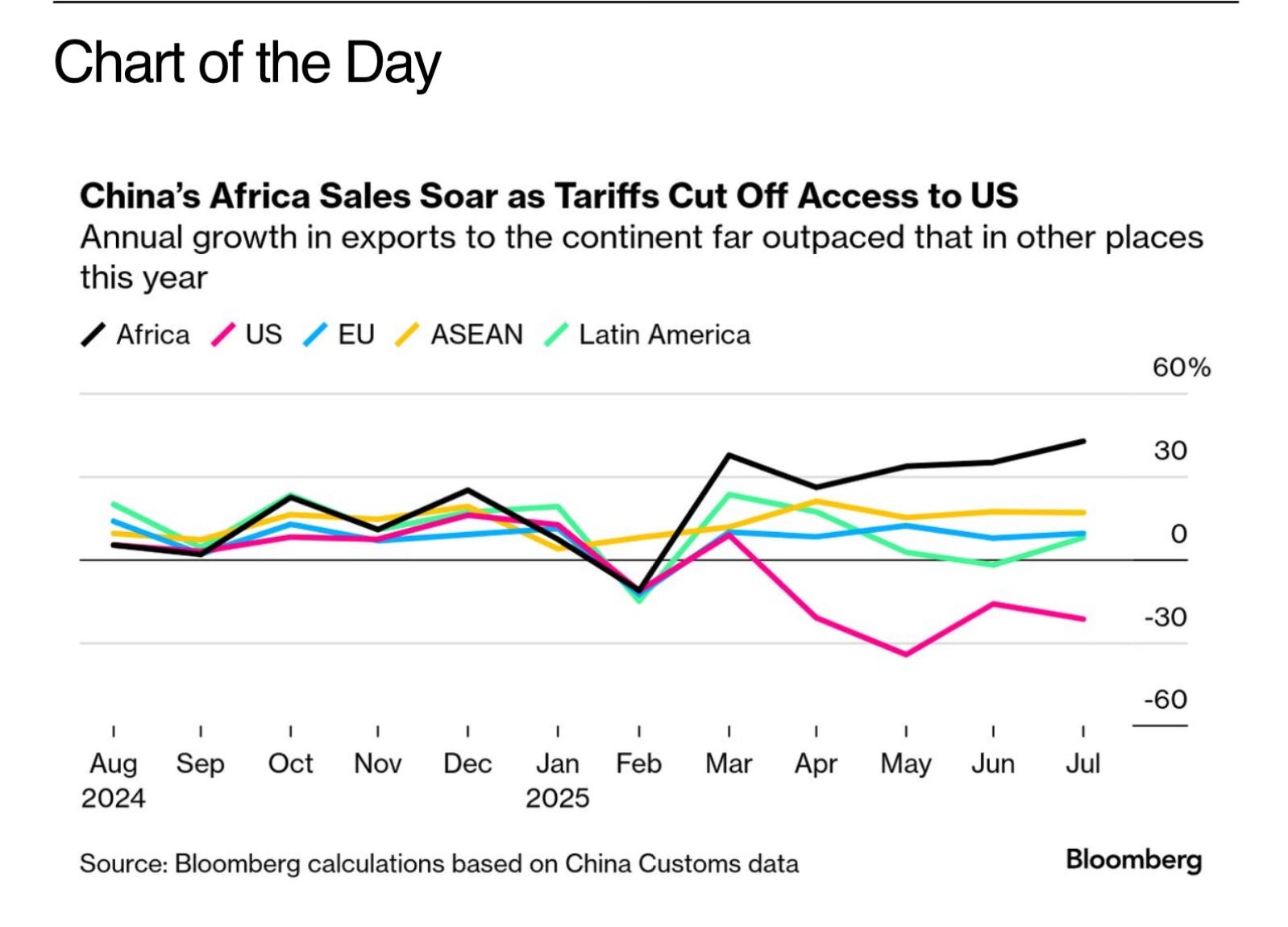
sharply after Trump’s “Liberation Day” announcement on April 2, Chinese exports to Africa soared. As Bloomberg reports:
[Chinese] sales to the continent of 1.5 billion people have climbed 25% from a year earlier in 2025 — a rate of growth far outpacing other major markets — while orders from the US slumped. China’s exports to Africa so far this year are on track to exceed $200 billion for the first time.
Africa is a huge, rapidly growing market, as its population explodes to 2.5 billion people by mid-century. It’s usually good business practice to try and capture a growing market. China gets that. America, it would appear, not so much.
A US Invasion of Venezuela
Is the United States about to invade Venezuela? Preposterous, you might say.
But this Financial Times story suggests otherwise:
The Pentagon is deploying warships to waters around Central and South America, an unusually large naval build-up that has stoked tensions with Venezuela and other Latin American countries.
he US Navy has sent at least seven vessels, including three guided-missile destroyers, an amphibious assault ship and a guided-missile cruiser, according to people familiar with the matter. A nuclear-powered fast attack submarine has also been deployed, according to one person.
The Trump administration has billed the move, which involves thousands of sailors and marines, as part of its efforts to combat drug trafficking by cartels.
The White House has used increasingly hostile rhetoric about Venezuela’s President Nicolás Maduro, referring to him as “illegal” and accusing him of trafficking drugs.
Maduro called up militiamen in response to the US deployment, while Colombian President Gustavo Petro has suggested his country’s armed forces could support Venezuela if it is attacked.
Asked whether the US was planning to deploy troops in Venezuela, White House press secretary Karoline Leavitt said last week that Trump was “prepared to use every element of American power to stop drugs from flooding into our country”.
She added that Maduro was “not a legitimate president”.
“He is a fugitive head of this cartel,” she said.
Perhaps this is all part of a pressure campaign, to deter Venezuela’s designs on its neighbor Guyana and curtail drug runs from the area. But this is large naval force, capable of sending thousands of Marines quickly ashore. We’ve been here before, most recently in 1989, when the US invaded Panama and grabbed its strongman, Manuel Noriega. Is Nicolas Maduro next? This story, too, bears watching.
Three important things to watch as we tend to focus more on Gaza and Ukraine, if we focus overseas at all. (Not that there isn’t a lot happening domestically to capture our attention!)