

Why Did Trump Go to War against Iran?
Ten days after President Trump decided to launch massive air strikes against Iran, the question why he did still has no good answer. Except for hubris.

From the time of his video address in the middle of the night on February 28, President Trump and his advisers have offered multiple explanations for why the US decided to go to war against Iran. None have held up to scrutiny. Which leaves the question: Why did Trump go to war ?
The only answer, I have concluded, is that Trump decided to go to war because he could. Having engaged in seven military operations before giving the order to strike Iran 11 days ago, including most importantly the daring raid to capture the Venezuelan strongman Nicolás Maduro in early January, Trump concluded that he now had the power to do what he wanted, and toppling the Iranian regime is something he wanted to do. Because he thought he could. We have a word for that — hubris.
Shifting Rationales, None Convincing
Starting with his video address, weirdly delivered in the middle of the night, not from the Oval Office, as presidents normally do, but from Mar-a-Lago, dressed with a baseball cap covering his eyes and without a tie, the president and his aides have offered multiple rationales for launching the war. The United States was responding to an “imminent threat”; negotiations to end Iran’s nuclear program had failed; Iran’s ballistic missiles posed a threat to the region and, soon, to the United States; Israel was going to strike so we had to strike before Iran could. None stand up to close scrutiny.
Imminent threat. In his Truth Social video, Trump explained that the reason he went to war was “to defend the American people by eliminating imminent threats from the Iranian regime.” But while the Islamic Republic of Iran is an odious regime and has the blood of thousands, including Americans, on its hand, on February 28, 2026, Iran in no way constituted an “imminent threat.” Its economy was in shambles. Its people were deeply resentful of the regime but cowed after the brutal repression that killed many thousands and jailed tens of thousands the previous month. Its nuclear program was buried under ground because of US and Israeli strikes the previous June. Its missile program was large, but also had been damaged by Israeli strikes eight months earlier. Rather than planning an attack, Tehran was focused on negotiating with the United States on its nuclear program and preparing for detailed technical talks in Vienna two days later.
Iran was going to strike first. Having failed to make the case for an imminent threat, Trump explained that he decided to strike because he had “a feeling” Iran would strike first. White House Press Secretary Karoline Leavitt explained on March 4 that the president "had a good feeling that the Iranian regime was going to strike the United States' assets and our personnel in the region.” Indeed, Trump himself explained that “It was my opinion that they were going to attack first. They were going to attack if we didn’t do it.” Yet, with the largest deployment of US naval and air power in the region since the Iraq war in 2003, Iran was in no position nor had any incentive to strike first. “Feelings” and unsubstantiated “opinions” are no reason to go to war.
Israel was going to strike. Secretary of State Marco Rubio put his own twist on the idea that Iran was going to strike first, saying that Israel was going to attack and then Iran would respond by attacking US bases and personnel. “We knew that there was going to be an Israeli action,” Rubio said on March 2. “We knew that that would precipitate an attack against American forces, and we knew that if we didn’t preemptively go after them before they launched those attacks, we would suffer higher casualties.” Rubio was right that Israel was going to strike. Prime Minister Bibi Netanyahu had informed Trump a few days earlier that new intelligence suggested that the Supreme Leader, Ayatollah Ali Khamenei, would be meeting with top commanders early Saturday morning, February 28, offering a tempting target to kill the leadership. Trump agreed to move the planned strikes up twelve hours to take advantage of the new intelligence. But this was a joint decision, certainly not (as Rubio implied) forced upon the United States by Israel. Indeed, as Trump himself said the next day in answer to whether Israel had forced his hand, “If anything, I might have forced Israel’s hand.”
Iran didn’t negotiate seriously about ending its nuclear program. The US Ambassador to the United Nations, Mike Waltz, told the UN Security Council that the United States was acting out of self-defense: “The United States has made every effort to negotiate a peaceful resolution of this conflict with Iran, but Iran has failed to take that opportunity. So in close coordination with the government of Israel, the United States has taken lawful actions to address these threats, in line with article 51 of the charter of the United Nations.” Leaving aside that preventive war is hardly justified under article 51 (which limits self-defense to when “an armed attack occurs”), the negotiations with Iran had only just started. No doubt, Iran was playing hard ball, as is its want. But it is also clear that the US negotiators, Steve Witkoff and Jared Kushner, lacked the expertise to know whether a real deal was possible. Witkoff, for example, claimed that Iran could produce bomb-grade material in "one week, maybe 10 days at the outside." But that would be true only if Iran had access to the highly enriched uranium that was deeply buried by the 2025 strikes and, most importantly, a sufficient number of operating centrifuges, all of which were said to have been “obliterated” last June. In other words, Iran was hardly a few weeks away from breakout or a nuclear weapon.
Iran would soon be capable of launching missiles that could reach the United States. During his State of the Union delivered days before the strikes, and again after he had started the war, Trump warned that Iran would soon have missiles capable of striking the United Sates. "The regime already had missiles capable of hitting Europe and our bases, both local and overseas, and would soon have had missiles capable of reaching our beautiful America.” But there is no intelligence that backs up this claim. The last, publicly available, intelligent report puts Iran’s capacity to build intercontinental-range missiles by 2035 “should Tehran decide to pursue the capability.”
“Something had to be Done”
The constantly shifting public rationales for going to war underscore that none were the real reason for making this momentous decision. Momentous not only because it set the United States, Israel, Iran, the region, and the world on a deeply perilous course. But because Donald Trump had run for President in 2016 and again in 2024 on the promise, as he put it in his 2024 election night victory speech, “I’m not going to start wars, I’m going to stop wars.”
And, yet, here Trump embarked on the quintessential war of choice, which Richard Haass, who coined the phrase, defined as: wars that “involve less than vital interests and are fought even though other policies — including diplomacy, sanctions, covert action and deterrence — could arguably have been employed.”
Why choose war, when choosing war wasn’t necessary? That is the unanswered question that so many people are asking. Trump’s own explanations have been all over the place, but there is one rationale he keeps coming back to: “Something had to be done.”
In making the case for war in the middle of the night, Trump went through the litany of horrors inflicted by the Iranian. “For 47 years, the Iranian regime has chanted ‘Death to America’ and waged an unending campaign of bloodshed and mass murder, targeting the United States, our troops and the innocent people in many, many countries.” There were the hostages held for 444 days. The Marine barracks and Embassy bombings in Beirut. The attack on the USS Cole. The roadside bombs in Iraq and Afghanistan that wounded, maimed, killed thousands. The proxies in Lebanon, Syria, Iraq, and Israel. The list goes on.
So, something had to be done.
But why now? Clearly, Israel was preparing to strike Iran, claiming Iran’s ballistic missile program was being reconstituted and wanting to end what it had started last June. Then Trump had called on Netanyahu to stop the attacks, well short of Israel’s objective of toppling the regime. Since then, Netanyahu spent months talking to Trump over the phone and in three US visits to convince the American president that he had an opportunity to end the Iranian threat and regime for good. Trump was perfectly capable of telling Netanyahu no. He had done so before, and if he didn’t want to go to war against Iran he could have told the Israeli leader off in no uncertain terms. But he didn’t.
Trump had deployed an “armada” to strike Iran — more naval and air power in the region than at any time since the Iraq War in 2003. If that was meant to intimidate Iran and force a positive outcome in negotiations, Trump never really tried that kind of coercive diplomacy. As soon as the Gerald R. Ford, the largest US aircraft carrier, was in position in the eastern Mediterranean, Trump ordered bombs away: “Operation Epic Fury is approved. No aborts. Good luck.”
This was Trump’s decision. And his alone.
Hubris. It’s Always Hubris
The reason for his decision, I believe, lies in the fatal disease that strikes presidents and powerful men: hubris. George W. Bush and his advisers believed that the ease with which they had ousted the Taliban regime in Afghanistan in 2001 could be repeated in Iraq in 2003. Donald Trump believed that the operational success in Venezuela could be replicated in Iraq. Both Bush and Trump ignored the very different circumstances that existed in Afghanistan and Venezuela compared to Iraq and Iran. Both overestimated what military power could accomplish on its own. And both ignored the unintended consequences of war — consequences that stand out all the more because the decision to start a war was a choice, not a necessity.
Trump believed that because he overcame the risks in Venezuela he would overcome the risks of going to war in Iran. “No president was willing to do what I am willing to do tonight,” Trump boasted, telling the Iranian people, “now you have a president who is giving you what you want.”
But the reason no president had gone to war with Iran is that they understood the risks. Iran was sure to lash out not only against Israel, but against its neighbors (as it had repeatedly said it would in response to a US attack). Iran could threaten access to the Strait of Hormuz, try and destroy oil and gas facilities in neighboring countries, with dire consequences for the global energy market. Iran could embark on terror, not only around the region but around the world. And while the Iranian people hated their regime, the security forces would likely be strong enough to maintain control.
In other words, presidents before Trump judged, correctly, that the costs of going to war outweighed the benefits. But Trump ignored costs and only focused on the benefits. He was confident in his ability to win. That’s what hubris does to leaders.
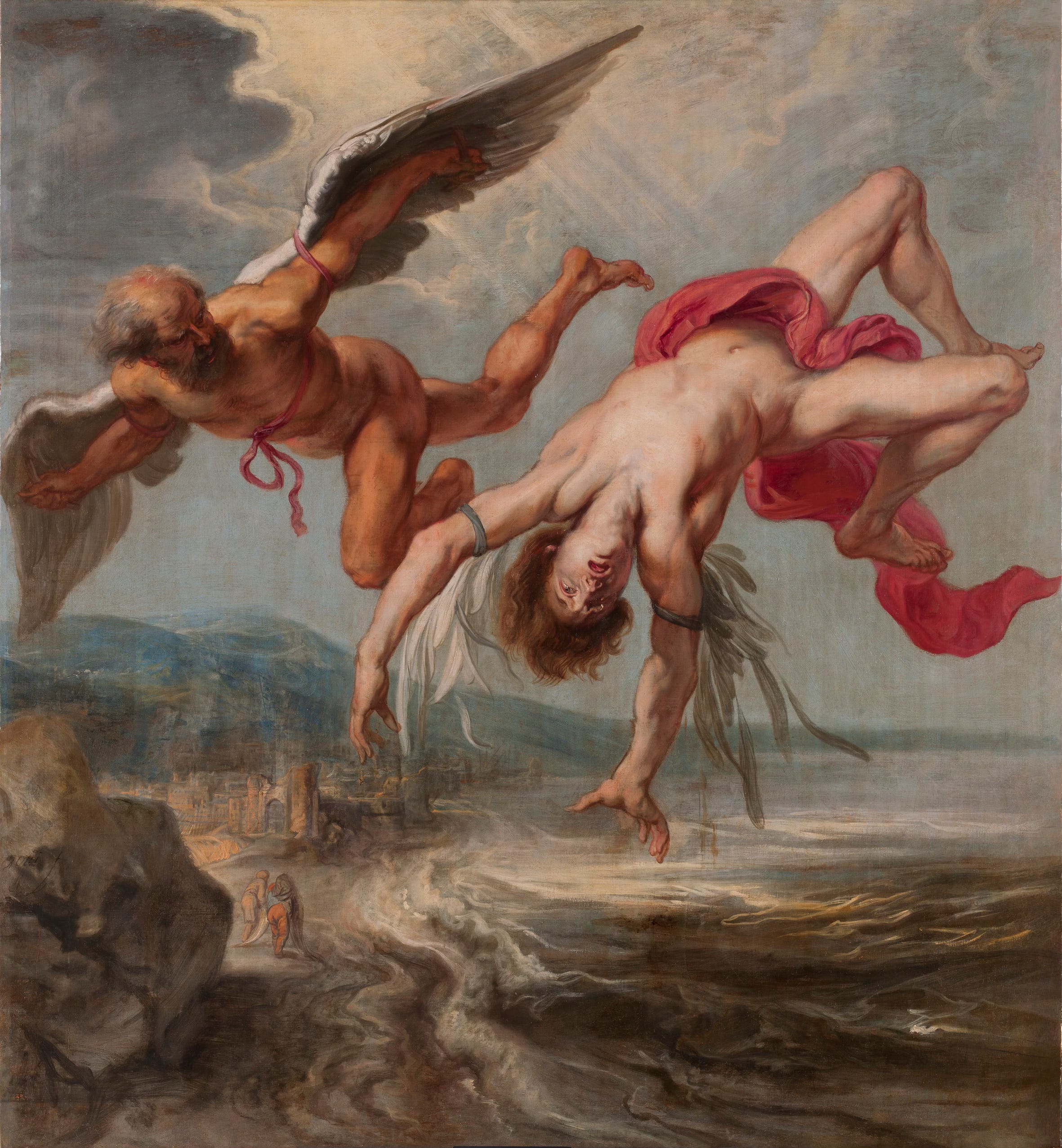
Trump may turn out to be Icarus, whose hubris convinced him that he cold fly as high as the gods on wings made of feathers and wax. He flew too close to the sun, and when the wax melting, he plummeted into the sea.
Hubris is a pretty good explanation.
https://avddemocracy.substack.com/p/the-scenario-where-iran-wins