


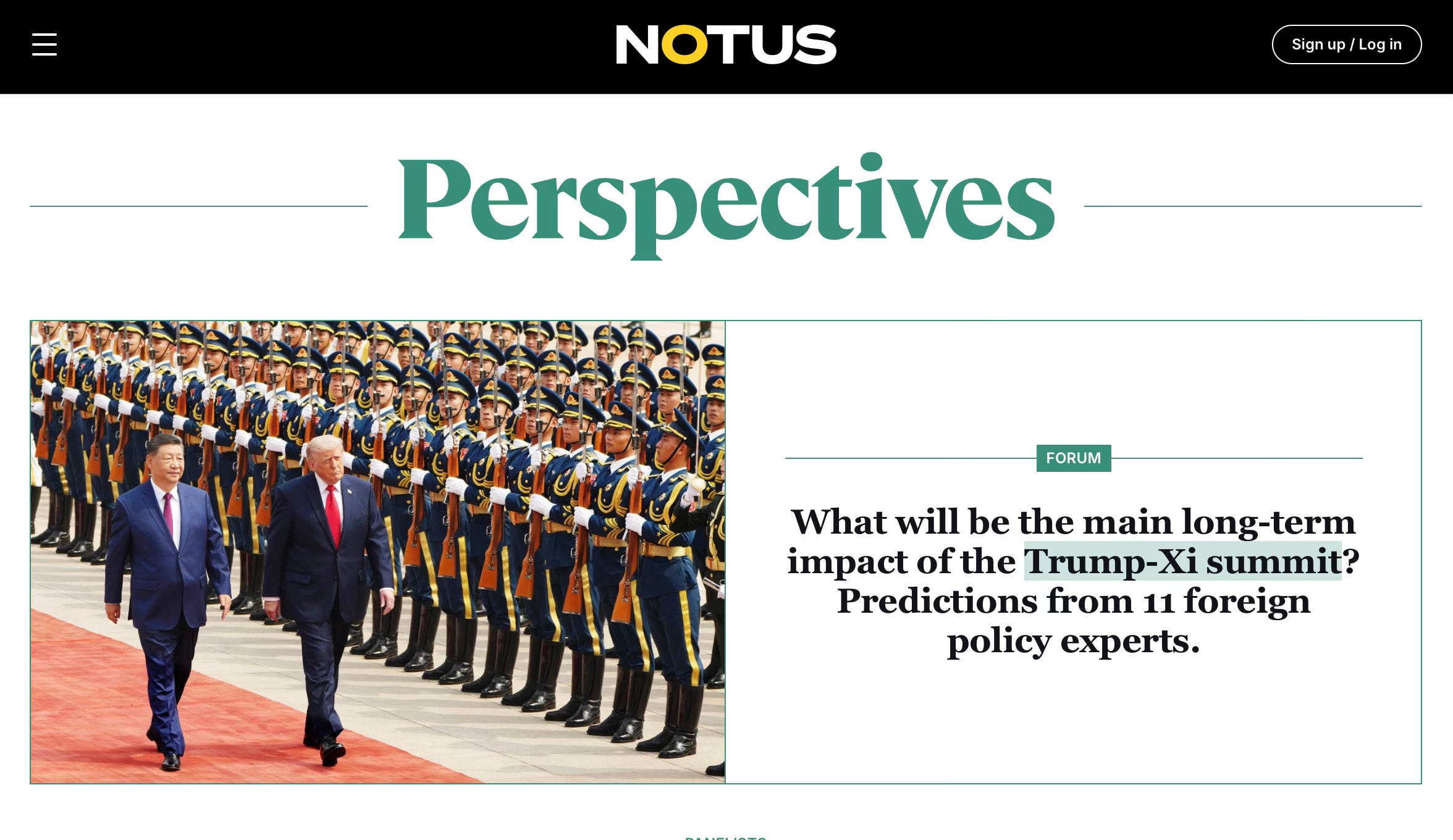
NOTUS Perspectives asks policy experts to give their views on key policy questions in 2 short paragraphs. This week, the question was about the main long-term impact of the Trump-Xi Summit. This was my answer:
For the first time in history, a U.S. president traveled for a summit meeting to China as a supplicant, rather than demandeur. The Chinese president played his part, as Xi Jinping received Donald Trump like a ruling emperor meeting one of his subjects. Xi redefined the terms of the Sino-U.S. relationship from a previous insistence that Beijing sought “win-win cooperation” to a new phase of “constructive strategic stability.” But this time, it would be China who determined what behavior contributed to stability and where the red lines would be drawn. For Xi, that line was Taiwan, which he defined, according to a spokesperson, as “the most important issue in China-U.S. relations,” while warning the United States not to take actions that could result in “clashes and even conflicts.”
Commentators have heralded this era as a “new détente.” It is nothing of the sort. Xi wants predictability, at least for so long as Trump is in power. He is willing to provide the mercurial president with some economic goods — buying new aircraft and loads of soybeans — that Trump can tout as big wins back home. But Xi is setting the terms of the relationship, not Trump or the U.S. And that will have lasting impact on the world going forward.
I wonder when the Republican Party will stop playing the game. After or before WW3?