

What Caught My Eye (no. 66)
Some interesting articles and podcasts that caught my eye this week

Here’s this week’s edition of articles I thought worth reading and sharing. Don’t hesitate to recommend your own reads; I may include some as well.
Mick Ryan, “Losing on Every Dimension,” Marching Orders, June 8, 2026. A rigorous five-dimensional assessment of Russia’s strategic position in 2026 concludes that Putin is losing not in one or two respects but across every measurable axis — military, cognitive, moral, industrial, and economic. On the battlefield, Russia is now losing more troops than it can recruit, suffering over 9,600 casualties per square mile gained in 2026 versus 200 in 2025, while Ukraine has for the first time seized a net territorial advantage over the past three months. Russia’s information operations are decoupling from a battlefield made transparent by open-source tracking, its moral standing is eroded by documented war crimes and a Gulf realignment toward Kyiv, its defence industrial growth has decelerated from 25 percent annually to a projected 5–7 percent, and its wartime economy — having exhausted the fiscal stimulus of 2023–24 — now faces 1 percent GDP growth, a labour shortfall of nearly 11 million, and food inflation above 20 percent. As Finnish President Alexander Stubb put it in May 2026: “The first year of this war for Ukraine was a struggle for survival. Then three years of resilience. And now it is pure mathematics.”
Megan K. Stack, “Israeli Expansionism Is Shaking the Middle East,” The New York Times, June 8, 2026. Since October 7, Israel has shifted from a strategy of containment to one of open expansionism — occupying swaths of southern Lebanon, carving into Syria, razing parts of Gaza, and accelerating West Bank settlements, while establishing covert bases in Iraq and reportedly planning a foothold in Somaliland. Stack argues that this acceleration, enabled by unconditional U.S. support, is generating strategic blowback: 60 percent of American adults now hold an unfavorable view of Israel, half believe it is committing genocide in Gaza, and the diplomatic and military lifeline on which Israel depends is showing signs of strain. Failed and fragmented states on Israel’s borders may look less threatening than the autocracies of a prior era, but they incubate the next generation of armed movements — a dynamic Israel already experienced when its 1982 invasion of Lebanon gave birth to Hezbollah. Stack closes with a stark assessment of American complicity: “Through money, protection and diplomatic overindulgence, the United States helped to create the aggressive Israel we see today.”
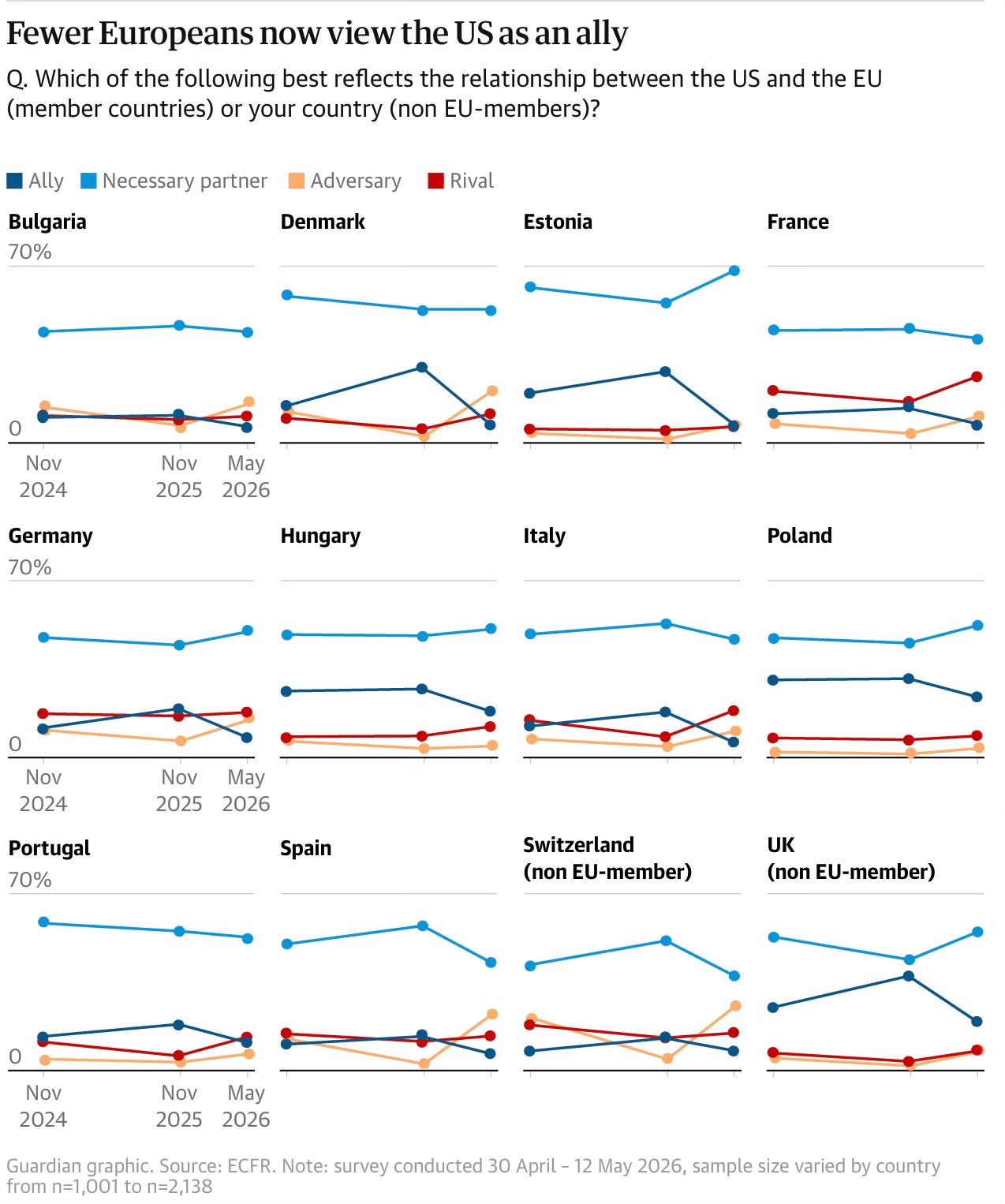
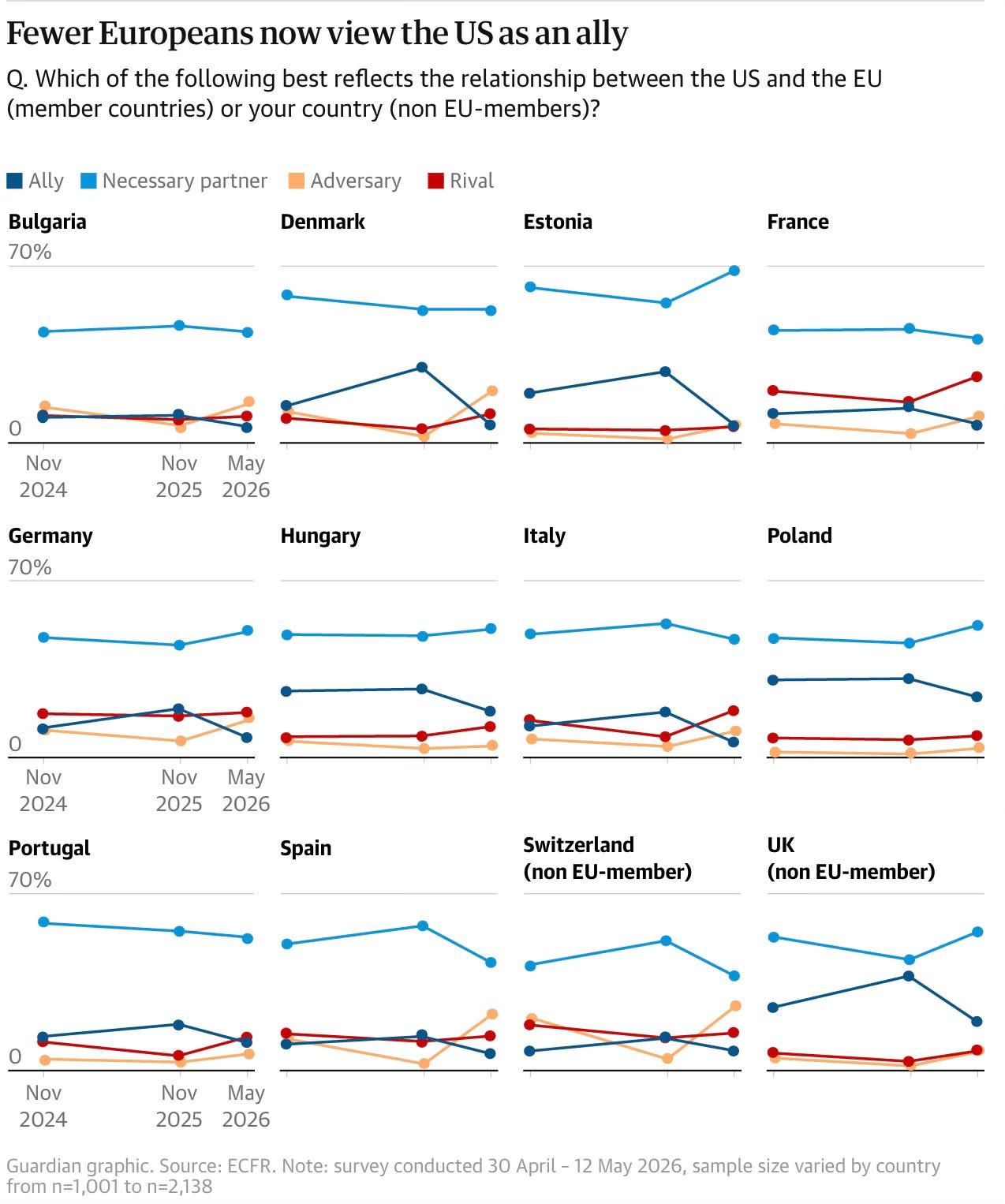
Jon Henley, “Only One in 10 Europeans Now See US as an Ally, Survey Suggests,” The Guardian, June 10, 2026. A 15-country European Council on Foreign Relations survey finds European confidence in the US security guarantee at a historic low, with just 11 percent now viewing Washington as an ally sharing their interests and values. Majorities in nearly every country no longer believe the US would come to their aid if attacked, while most expect at least some European neighbors would. The shift is driven by Trump’s Middle East aggression, threats against Greenland, talk of troop withdrawals, and skepticism toward NATO’s future, and is fueling growing support for “buy European” defence procurement and collective EU defence borrowing — though most Europeans still expect US-European relations to improve once Trump leaves office.
Rebecca Feng, “China Is Propping Up the World Economy by Importing a Lot Less Oil,” The Wall Street Journal, June 10, 2026. China has cut crude imports from roughly 11 million barrels a day to 7.8 million in May, a drop of about three million barrels — equivalent to the combined daily consumption of Italy and France — helping explain why Brent crude remains below $100 a barrel despite the Strait of Hormuz being effectively closed for four months. The shift reflects a structural diversification away from oil: rail and EV travel surged during the May Day holidays as air and gasoline-car use declined, while refiners and petrochemical plants have cut run rates by 7-10 percentage points and Beijing has only recently begun drawing modestly on reserves estimated at one billion to 1.4 billion barrels. Yet the resilience may be partly an illusion, as the petrochemical slowdown is starting to create feedstock shortages that pushed producer prices up 3.9 percent in May, raising the risk that reduced oil demand eventually feeds through into higher manufacturing costs.
Dario Amodei, “Policy on the AI Exponential,” darioamodei.com, June 2026. Amodei argues that AI’s exponential progress has now produced undeniable evidence of both its power and its risks — exemplified by Claude Mythos Preview’s demonstration of frontier-model cybersecurity risk — and that policy, which moves far slower than the technology, must urgently catch up across five domains: regulation and public safety, macroeconomics and tax policy, scientific innovation, the state and civil liberties, and geopolitics. He calls for FAA-style mandatory third-party testing of frontier models for cyber, bio, loss-of-control and automated R&D risks, alongside reforms to let regulators like the FDA adapt to an AI-driven flood of new drug candidates and therapies. On labor displacement, he warns that AI may act as a more thorough substitute for human cognition than past technologies and urges pro-employment incentives, and eventually long-term income support such as UBI, while on civil liberties he proposes bans on domestic autonomous weapons and closing data-broker surveillance loopholes. Geopolitically, he frames AI as a nuclear-weapons-level reset of the strategic landscape and calls for a coalition of democracies to control the AI supply chain, coordinate on risk, and reject AI-powered authoritarianism. The essay closes on a note of urgency tempered by optimism: “Treebeard and his forest are waking up.”
Lawrence Freedman, “Putin Has Missed His Best Opportunity for a Ceasefire,” Comment is Freed, June 13, 2026. Freedman examines why Putin rejected Zelenskyy’s June 4 offer of a face-to-face meeting and full ceasefire — made pointedly during the St. Petersburg International Economic Forum, just as Ukrainian drones struck the city’s oil terminal and a Black Sea Fleet corvette. Putin remains insulated by a stream of false battlefield reporting that protects him from the reality that Russian forces are stalling or retreating in most sectors. Freedman argues the real obstacle is not the military balance but the internal politics of the Kremlin: as Ukraine’s drone campaign increasingly isolates Crimea and degrades Russian logistics and oil export revenue (down 34 percent in early 2026), the gap between Putin’s public claims and battlefield reality may eventually prompt Russian elites to ask why a ceasefire wasn’t accepted earlier. As Freedman puts it, Putin’s recent statements increasingly “sound delusional while others show him in denial.”
Edward Wong, “Trump’s Sharp Turn on China: Embracing It as a Peer Power,” The New York Times, June 9, 2026. Following Trump’s Beijing summit with Xi Jinping, both governments adopted the phrase “constructive strategic stability,” signaling a marked accommodation that has unsettled officials from Taipei to Delhi to Manila. Trump praised Xi as a “central casting” leader, described a “G2” of equal superpowers, and is holding a $14 billion Taiwan arms package “in abeyance” as a negotiating chip — a shift that appears to violate the Taiwan Relations Act and the “Six Assurances,” while Trump has also publicly suggested Taiwan should “cool down” rather than risk war with China. The reversal follows China’s success in forcing a US retreat during last year’s trade war, and Beijing sees it as a long-sought validation of the “new type of great power relations” that Xi unsuccessfully pressed on Obama. Analysts warn the pivot is fraying the China-focused convergence that had underpinned US ties with India and other Asian partners, even as the Pentagon continues military exercises in the region. As one former Indian foreign secretary put it, “It doesn’t seem like this U.S. administration is interested in the broader geostrategic issues in Asia.”
Philip Gordon, “Don’t Give Up on Global Order,” Foreign Affairs, June 9, 2026. Against the emerging bipartisan consensus that the U.S.-led liberal order is dead and not worth reviving, Gordon argues the order delivered historically unprecedented benefits — preventing great-power war, curbing nuclear proliferation, lifting over a billion people from poverty, and expanding democracy — and that America retains the underlying strength to lead it again after Trump. He marshals data showing U.S. GDP now 40 percent larger than the EU’s and seven times Japan’s, a defense budget triple China’s, and dollar dominance in global reserves, while warning that abandoning alliances and freedom of navigation risks a cascade of nuclear proliferation, with over 75 percent of South Koreans now backing an independent arsenal and Poland, Germany, Saudi Arabia and Turkey all signaling similar interest. He points to Iran’s closure of the Strait of Hormuz after Trump’s February 2026 strikes — which sent gas prices up 50 percent and pushed some Asian economies to four-day workweeks — as a preview of the costs of ceding control of global chokepoints. Gordon’s prescription is reform rather than retreat: a renewed alliance bargain with greater burden-sharing, recommitment to rules and institutions, correction of trade overcorrections, and military humility, arguing that polling already shows Americans souring on Trump’s unilateralism and craving renewed global leadership.
Finally, below are links to some of the things I did and wrote this week.
I warned about the US decoupling security from Europe in my bimonthly Politico Europe column.
This month’s Ask Ivo discussed Russia, US standing in the world, European and other allies losing trust in America, and much more.
This week’s World Review focused on Iran, US-European relations, and the AI revolution.
Happy reading, watching, and listening! Stay safe.