

What Caught My Eye (no. 56)
Some interesting articles and podcasts that caught my eye this week


Here’s this week’s edition of articles I thought worth reading and sharing. Don’t hesitate to recommend your own reads; I may include some as well.
Patrick Foulis, “What the Iran war teaches America’s adversaries,” Financial Times, March 27, 2026. Foulis argues that the war reveals both American weakness and strength: attacking Iran has drained munitions, strained alliances, raised costs, and pulled attention and resources away from Asia. But it has also demonstrated astonishing military reach, precision, and economic resilience. For America’s adversaries, this creates a complex picture. Smaller adversarial regimes may conclude they need chokepoints or weapons of mass destruction to avoid interference or decapitation. While Xi Jinping likely welcomes America’s focus shifting elsewhere, China is confronted with its own vulnerability to economic shocks in a broader war.
Paul Sonne, Valerie Hopkins, and Oleg Matsnev, “Putin’s Internet Blackout: A Chaotic Drive to Cut Off Russians From the World,” The New York Times, March 31, 2026. The piece argues that the Kremlin is taking its boldest steps yet to bring Russian communications under tighter state control, using war and security justifications to normalize outages and platform restrictions. Using Ukrainian drone attacks as the pretext, the government is building tools it could use against domestic unrest. Telegram has become both a daily utility and one of the last relatively open spaces for news, dissent, and communication in Russia. The crackdown is not only political but also socially disruptive, causing problems with payments, transport, medical monitoring, and everyday life. Russians are finding workarounds, yet many seem to believe they have little real power to stop the tightening system controlling the flow of information.
Tej Parikh, “The Iran war will cement China’s superpower status,” Financial Times, March 29, 2026. Parikh, the economics leader writer for the Financial Times, argues that although China depends on energy supplies from the Middle East, it has spent years preparing for exactly this kind of shock through stockpiles, diversified supply routes, and a far more electrified economy than its rivals. The war may also strengthen China in the long run by increasing demand for green technologies, rare earths, refined fuels, and industrial inputs in which the country already dominates. The conflict may hurt China in the short term, but it is far more likely to reinforce the impression that China is the steadier, more strategically prepared power and increase its global influence.
Robert Kagan, “America Is Now a Rogue Superpower,” The Atlantic, March 30, 2026. Kagan, Senior Fellow at the Brookings Institution, argues that the Iran war is accelerating the breakdown of the alliance system that has underwritten American power since World War II. The war has hurt Ukraine, unnerved Europe and Asia, diverted forces from the Pacific, and strengthened Russia and China by driving a wedge between Washington and its allies. Trump treats allies less as partners than as dependents to be threatened, bullied, or coerced, which pushes them to hedge and search for alternatives. Kagan concludes that as confidence in American reliability collapses, more countries will hedge, drift away, or align against the United States, ushering in a lonelier and more dangerous era of a rogue superpower.
Janan Ganesh, “Trump learns that not everyone has a price,” Financial Times, April 1, 2026. Ganesh’s core claim is that Trump misreads the world because he assumes that everyone is ultimately transactional, when in fact states and leaders are often driven by ideology, nationalism, or belief. That is why Iran’s willingness to absorb punishment and Ukraine’s refusal to accept a settlement seem baffling to the President. The problem is compounded by the people around him, many of whom are themselves opportunists rather than true believers capable of explaining how conviction shapes foreign policy. The result is an administration poorly equipped to deal with regimes such as Iran, Russia, or China because the President follows what Ganesh calls a right-wing Marxist ideology that mistakes deeply held commitments for bargaining positions.
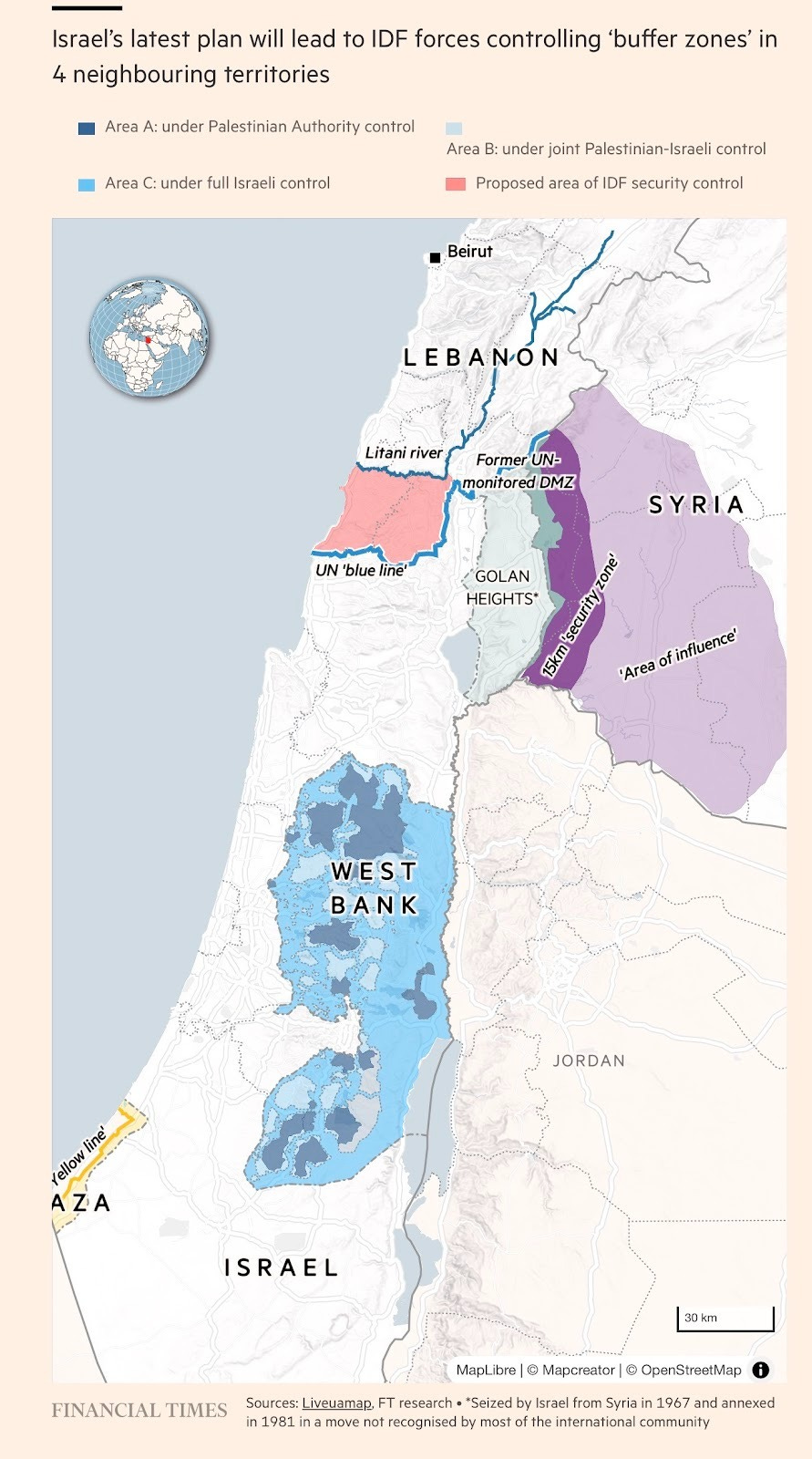
Neri Zilber, “One battle after another: Netanyahu’s new security doctrine,” Financial Times, April 1, 2026. Zilber’s argument is that Netanyahu has moved away from the language of decisive victory toward a doctrine of permanent pre-emption: strike first, hold buffer zones, and accept open-ended conflicts. October 7 marks a turning point for Israeli strategy in the region. While Netanyahu’s supporters argue that his sequence of wars has weakened Israel’s enemies and improved its regional position, critics see it as a post-traumatic reflex rather than a coherent grand strategy that is already straining the IDF. Zilber argues that Netanyahu may be winning battles, but he is leaving the country trapped in a costly and potentially unsustainable state of endless war. I found this map particurlarly striking:
Bret Stephens, “Yes, This Is Your War, Too,” The New York Times, March 31, 2026. Stephens argues that, however understandable the distaste for Trump’s handling of the war may be, America’s allies, Democrats, and the wider public still have a direct stake in an outcome that leaves Iran weaker and less able to cause disruption in the region. He contends that ending the conflict before reopening the Strait of Hormuz would amount to a strategic failure, because Tehran would read it as vindication, Gulf partners would feel abandoned, and Europe lacks the will and means to pick up the burden. His preferred approach is not immediate occupation but coercive pressure, including stopping Iranian oil exports until Iran allows energy flows to resume. Indifference is a luxury no one really has: an emboldened Iran would make the next round of American and allied choices much harder, no matter who is in office.
Finally, this was a very busy week, with America appearing increasingly stuck in Iran with no easy way out, and President Trump repeatedly threatening to leave NATO due to his displeasure with allies. Below are links to some of the things I did and wrote this week.
My POLITICO column explained the shortcomings of President Trump’s tendency to go with his guts and relying on negotiators without the diplomatic skills and knowledge necessary to deal with adversaries like Iran. I delved deeper on how Steve Witkoff likely didn’t understand the deal Iran was offering before the war in America Abroad.
I argued that the current crisis in NATO is the worst ever in its 77-year history in America Abroad. The piece and argument generated a lot of interest. I spoke to The Guardian, New York Times, The Telegraph, NBC News, Axios, CNN News.
NATO and Trump’s threats to leave were also major topics of interviews I did this week on MSNOW’s 11th Hour with Stephanie Ruhle, CNN News Central, CNN International, Fox News Rundown Podcast, As It Happens, and All Things Considered.
I spoke with France24 and Al Jazeera about the President’s speech on the war in Iran.
I joined Diane Rehm to discuss how Steve Witcoff and Jared Kushner failed to understand Iran's serious proposals.
Finally, this week’s World Review focused on the implications of the Strait of Hormuz closing, Israel’s military campaign in Lebanon, and Trump’s speech on his objectives in Iran.
Happy reading, watching, and listening! Stay safe.