

What Caught My Eye (no. 55)
Some interesting articles and podcasts that caught my eye this week


Before diving into this week’s read, a couple of things that struck me about the Iran War this week (for my own analysis and perspective, please see links at the end).
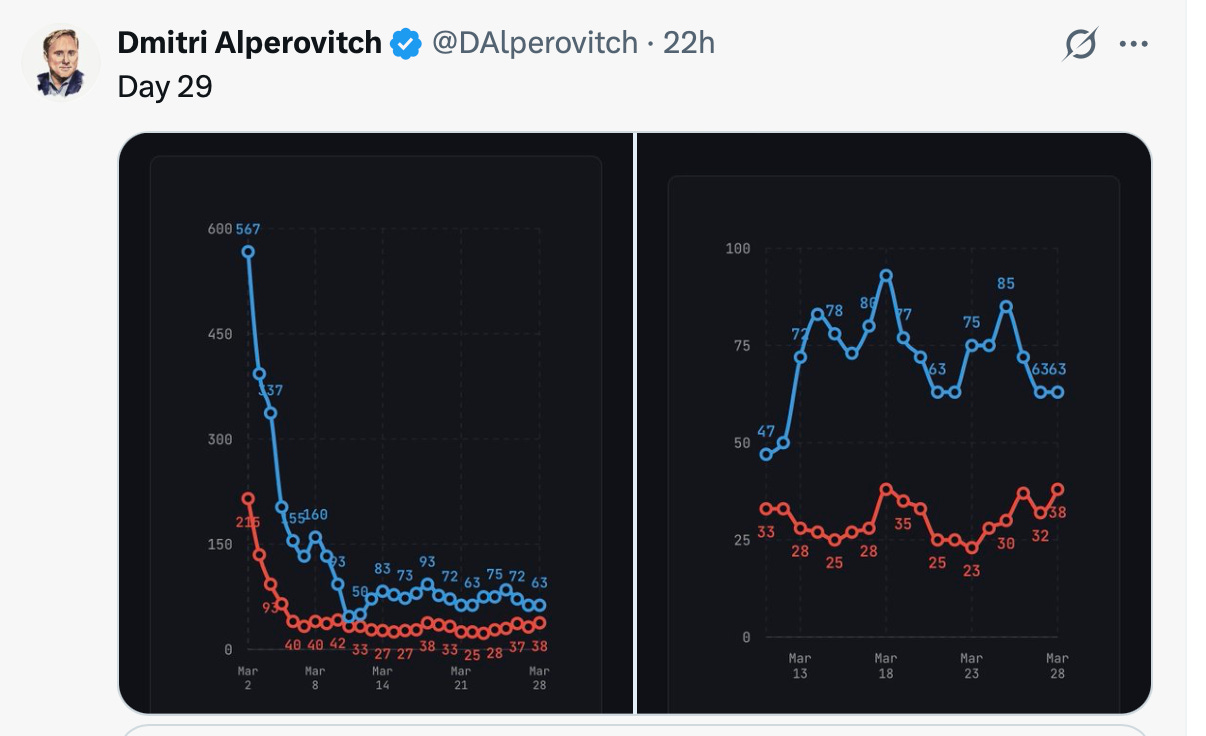
The administration, from the president on down, has made much of how effective the bombing campaign has been – notably with respect to destroying the ballistic missile threat, which was one of the principal reasons for going to war. We’re told, repeatedly, that Iran’s ballistic missile launches are down 90 percent. True. But largely irrelevant. The big question is what does Iran have left, and how much damage it can do. And on this, the news is not good. A report by Reuters cites five intelligence sources to argue the US can confirm that about a third of Iran’s missile arsenal has been destroyed, and perhaps another third buried deep underground and possibly destroyed. That still leaves a third of its arsenal intact. As a result, the rate of Iranian missile and drone fire has remained remarkably consistent – and their effectiveness, the New York Times reports, has steadily increased. Dmitri Alperovitz has tracked Iranian drone and missile strikes and his daily graphs are instructive.
Iran’s control of the Strait of the Hormuz is a bigger deal than much of the analysis to date appears to assume. Iran is controlling access through the Gulf, making money by sending its own oil and gas through the Strait, and charging others $2 million or more per tanker to cross the Strait. The Trump administration appears to assume that Iran will continue to control access even after the war ends, and isn’t taking the lead in trying to prevent it. “One of the immediate challenges that we are going to face is an Iran that may want to set up a tolling system in the Strait of Hormuz,” Marc Rubio said on Friday. “It is important that the world have a plan to confront it. The U.S. is prepared to be a part of that plan. We don’t have to lead that plan, but we are happy to be a part of it. But these countries have a lot at stake, not just the G7 countries but countries in Asia and all over the world have a lot at stake and should contribute greatly to that effort.”
Finally, the first US Marines arrived in the region–a month after the war started. Nothing underscores the lack of planning and the best-case assumptions behind “Operation Epic Fury” is the fact that ground forces were not in place in case those assumptions didn’t pan out. All the talk of ground forces – of delivering the “final blow” as Axios reported this week – just underscores how unprepared the administration was when the president decided to go to war. As Lawry Freedman put it in a perceptive take on the state of the war: “Talk of ‘final blows’ should come with flashing warning signs. The language, reflected even more in Hegseth’s hyperbolically belligerent rhetoric, almost as if shouting at the enemy will cause it to surrender, assumes that the enemy’s pain threshold will soon be reached or vital capabilities are about to be lost. None of this reflects any sense of what it takes to defeat a regime fighting for its survival.”
Now, here’s this week’s edition of articles I thought worth reading and sharing. Don’t hesitate to recommend your own reads; I may include some as well.
Phil Klay, “Trump Has Made a Fundamental Miscalculation about Iran,” The New York Times, March 22, 2026. Klay, Marine Corps veteran of the Iraq war and author of the book Redeployment, argues that the administration’s case for war is not just incoherent but morally questionable. The stated objectives keep shifting, and the administration seems driven less by strategy than by a fascination with violence, domination, and spectacle. This marks a break with an American tradition of treating war as a grave instrument tied to clear political ends. Using force without clear ends is both strategically foolish and morally corrupting, and may end up strengthening the very regime it seeks to weaken.
Kim Ghattas, “History is tragically repeating itself in Lebanon,” Financial Times, March 21, 2026. Ghattas, Fellow at Columbia University’s Institute of Global Politics, draws parallels to Israel’s 1982 invasion of Lebanon, which contributed to the creation of Hezbollah and set Lebanon on the path to becoming a recurring battleground. But what is different is the Lebanese government’s response. Ghattas argues the West should be supporting Lebanon in its efforts to counter Hizbollah, rather than sitting on the sidelines for another Israeli occupation that would embolden the militia.
Lisa Baertlein and Jonathan Saul, “Western powers were unable to secure shipping in the Red Sea. Hormuz will be harder,” Reuters, March 25, 2026. The West struggled to secure shipping against the Houthis despite billions of dollars and a major military effort. Given Iran has better capabilities, a more favorable geography, and more ways to threaten ships than the Houthis did, reopening the Strait of Hormuz will be significantly more difficult. Baertlein and Saul emphasize the scale of the economic stakes and the military reality that even a few mines or drones could keep insurers and shippers away, which is all Tehran may need.
David French, “‘Everything After This Will Be Harder’: Gen. Stanley McChrystal on Iran,” The New York Times, March 23, 2026. In this podcast, General Stanley McChrystal argues that Americans repeatedly fall for the illusion that covert action, special operations, and air power can produce clean political outcomes. The easy part is the opening bombardment, but the hard part begins once grievances, economic costs, and rising casualties turn the war into a more equal struggle than Washington imagines.
Nahal Toosi, “Why Marco Rubio Is Escaping the Brunt of Fury Over Iran,” POLITICO, March 24, 2026. Despite his role in reducing the size of the NSC and weakening interagency coordination, Marco Rubio has largely managed to escape criticism over the war against Iran. Toosi argues that this may be a sign that Washington still views Rubio more as Secretary of State than as the man running the National Security Council.
Marc Daalder, “What I’ve learned (and saved) in my first year owning an EV,” Newsroom, March 24, 2026. As gas prices are going through the roof, some may be thinking about switching to an electric vehicle and abandoning the gas-guzzling internal combustion engine. If you are one of these people, Marc Daalder (yes, we are related) reports on his 10-month experience of owning an EV. Yes, he lives in New Zealand (and therefore his driving habits are more comparable to those in Europe than in the US), but the math (or maths, as they would say down there) is still instructive. And please excuse the shameless plug!
Nancy A. Youssef and Missy Ryan, “The U.S. and Iran Are Fighting a Massively Asymmetrical War,” The Atlantic, March 25, 2026. Although the US and Israel dominate in conventional military terms, Iran has managed to shift the balance of power in their favor by using low-cost drones and strategic disruption to global trade. The regime does not need to win. It only needs to keep the Strait of Hormuz dangerous and energy markets unstable enough to turn American tactical victories into a war of attrition and frustration.
Victoria Guida, “Carney’s Grand Ambition On Trade Does Not Include Trump,” POLITICO, March 26, 2026. Guida, Economics correspondent at POLITICIO, describes an emerging effort by Mark Carney and other middle powers to build a trade alignment around the EU and CPTPP that would reduce their exposure to US tariff politics and preserve some version of a rules-based order without Washington at the center. This marks a clear shift in their response. America’s allies are no longer merely complaining about Trump’s trade policy but beginning to organize around the possibility that the US can no longer be relied on to lead.
Martin Wolf, “We must not underestimate the peril for democracy,” Financial Times, March 25, 2026. Wolf, Chief Economics Commentator at the Financial Times, argues that the US has turned into a prime example of democratic deterioration, a global crisis that risks deepening into a democratic depression. His warning is that the real danger is not just bad leadership or polarization but a rapid executive assault on the institutional constraints, legal norms and civic freedoms that make liberal democracy possible in the first place.
“A Conversation with Antony J. Blinken, 71st U.S. Secretary of State,” Institute of Politics Harvard Kennedy School, March 25, 2026. In this conversation with David Sanger, former Secretary of State Blinken criticizes the Trump administration for failing to make a clear case to the American public for war with Iran. He argues that the old postwar divide between democracy and autocracy is giving way to a messier world of issue-specific coalitions that must still operate by shared rules
Finally, in case you missed it, here are links to some of the things I did and wrote this week.
I spoke to Bloomberg about the strategic implications of the Strait of Hormuz and shared my detailed assessment in America Abroad.
I wrote in POLITICO and spoke to abcNews about why the war with Iran will have far greater strategic consequences than the war in Iraq in 2003.
I spoke with Lev Parnas about Iran, Ukraine, North Korea, nuclear proliferation, and Russia.
I responded to President Trump’s most recent criticisms of NATO in America Abroad.
Finally, this week’s World Review focused on escalation with Iran, Trump’s criticism of NATO, and recent elections in Europe.
Happy reading, watching, and listening! Stay safe.
He is lying by saying the US won’t be affected too! 😡