

Trump Started a War He Can't End Alone
My interview with Yannis Palaiologos in the Greek Daily, Khatimerini


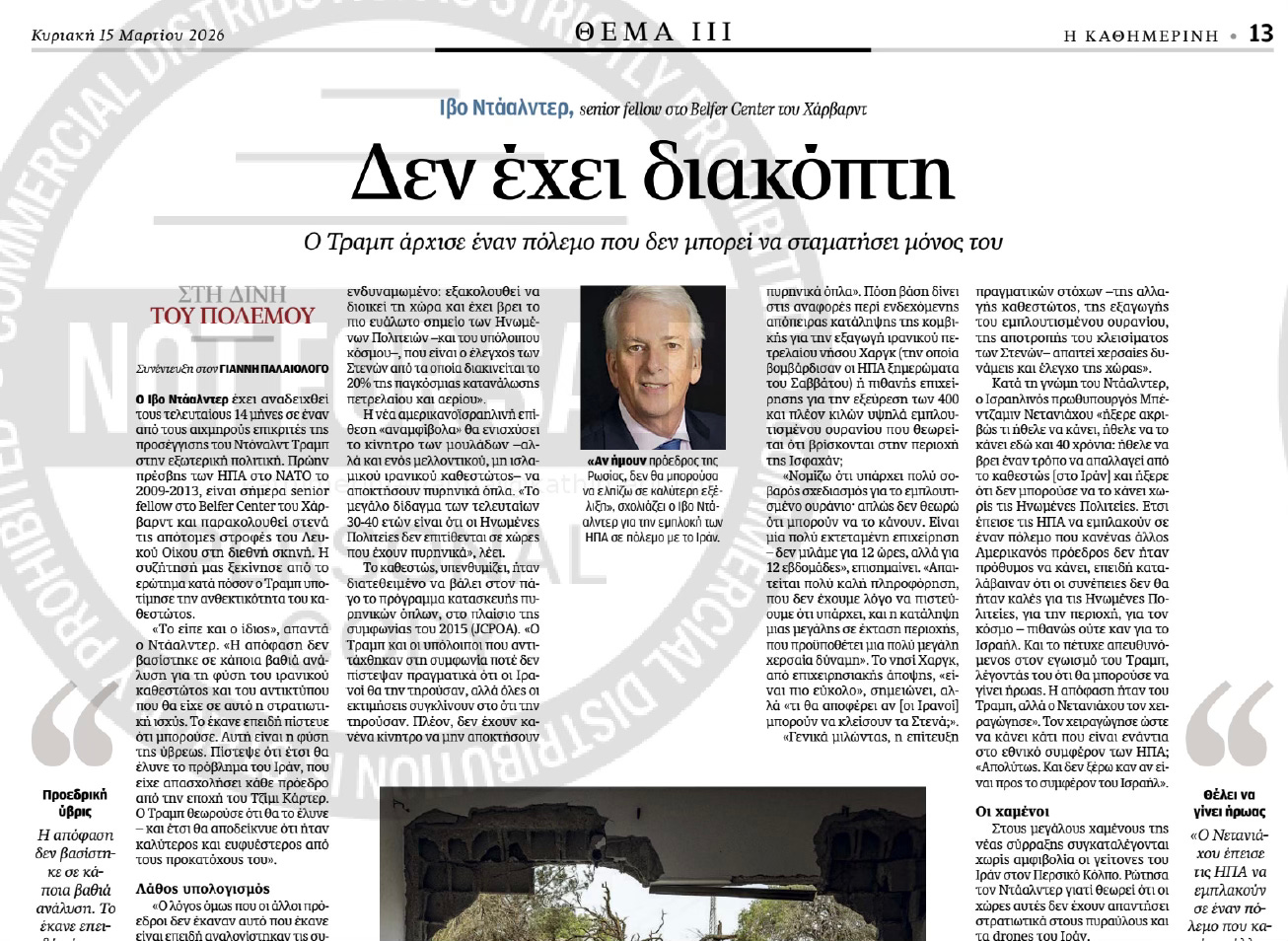
Last week, I had the pleasure of speaking with Yannis Palaiologos, a feature writer for Khatemerini, the major Greek daily. Here is a translation of the interview:
Ivo Daalder has emerged over the past 14 months as one of the sharpest critics of Donald Trump’s approach to foreign policy. A former US ambassador to NATO from 2009 to 2013, he was then president and CEO of the Chicago Council on Global Affairs for 12 years . Today, as a senior fellow at Harvard’s Belfer Center, he follows closely – and with growing concern – the White House’s sharp turns on the international stage and the consequences they are having on the web of alliances that Washington painstakingly built after 1945.
When we managed to communicate, despite the 13-hour time difference with New Zealand where he was, I began by asking him to what extent he believed Trump had misread Iran’s ability to resist and the regime’s resilience.
“A great deal. He said so himself,” Daalder replies. In a sense, he notes, it is wrong to even talk about misinterpretation. “The decision was not based on any deep analysis of the nature of the Iranian regime and the impact that military power would have on it. He did it because he thought he could, without studying it. That is the nature of hubris.”
Presidential hubris – The decision was not based on any deep analysis. He did it because he believed he could. That is the nature of hubris. He believed that this would solve the problem that had plagued every president since Jimmy Carter.
The successful recent military interventions, Daalder explains, made Trump believe that “US military power is so overwhelming that it can achieve anything. And he believed that this would also solve the Iran problem, which had preoccupied every president since Jimmy Carter. Trump believed that he would solve it – and thus prove that he was better and smarter than all his predecessors.”
“But the reason other presidents didn’t do what he did is because they thought about the consequences ,” he continues. “They understood how difficult it is to change regimes. They understood that Iran was a revolutionary regime with a revolutionary ethos and, therefore, would resist to the last Iranian; that a regime that is willing to kill thousands of people to maintain power would not be shaken by missile strikes.”
Does Trump have the time to end the war and avoid the worst? Doesn’t Iran have a say in when the hostilities will stop? “Of course they had a say. This was perhaps his biggest miscalculation: he thought he could start and stop the war with a switch. Trump often makes this mistake. He forgets that others also have the ability to act. Perhaps a week ago he could have successfully declared victory and withdrawn. Now, after bombing 5,500 targets, the regime feels empowered: it continues to rule the country and has found the most vulnerable point of the United States—and the rest of the world—which is control of the Straits through which 20% of the world’s oil and gas consumption is transported.”
The former US ambassador to NATO considers the idea of eliminating Tehran’s nuclear ambitions by military means equally problematic. The new US-Israeli attack will “undoubtedly” strengthen the incentive of the mullahs—and of a future, non-Islamic Iranian regime—to acquire nuclear weapons. “The big lesson of the last 30-40 years is that the United States does not attack countries that have nuclear weapons,”he says, noting, however, that it is “a reasonable question” how long it would take Iran to achieve this goal after the strikes of June 2025 and the current war.
The regime, he recalls, was willing to put its nuclear weapons program on hold, under the 2015 agreement (JCPOA). “Trump and the others who opposed the agreement never really believed that the Iranians would abide by it, but until he withdrew from it they by all accounts did. Now, they have no incentive not to acquire nuclear weapons.”
How much basis does he give to reports of a possible attempt to seize the key Iranian oil export island of Kharg (which the US bombed early Saturday morning) or a possible operation to find the 400-plus kilograms of highly enriched uranium believed to be in the Isfahan area?
“I think there is a very serious plan for enriched uranium; I just don’t think they can do it. It’s a very large operation—we’re not talking about 12 hours, we’re talking about 12 weeks,” he says. “It requires very good intelligence, which we have no reason to believe exists, and the occupation of a large area, which requires a very large land force.” Kharg Island, from an operational point of view, “is easier,” he notes, but “what would it yield if [the Iranians] could close the Straits? ”
“Netanyahu convinced the US to get involved in a war that no other American president was willing to fight. And he did it by appealing to Trump’s ego, telling him he could be a hero.”
“Generally speaking, achieving real goals—regime change, exporting enriched uranium, preventing the closure of the Straits—requires ground forces and control of the country. That’s why no one has attempted it.”
The Netanyahu factor
The discussion turns to Israel’s role. Daalder says that Israeli Prime Minister Benjamin Netanyahu “knew exactly what he wanted to do, he had wanted to do it for 40 years: he wanted to find a way to get rid of the regime [in Iran], and he knew he couldn’t do it without the United States. So he convinced the United States to get involved in a war that no other American president was willing to start, because they understood that the consequences would not be good for the United States, for the region, for the world—probably not even for Israel. And he did it by appealing to Trump’s ego, telling him that he could be a hero. The decision was Trump’s, but Netanyahu manipulated him.”
Did he manipulate him into doing something that is against the national interest of the United States? “Absolutely. And I don’t even know if it’s in Israel’s interest.”
Inside the bay?
The big losers in the new conflict are undoubtedly Iran’s neighbors in the Persian Gulf. I asked Daalder why he believes these countries have not responded militarily to Iran’s missiles and drones.
“For two reasons. First, there is nothing they can do that the United States and Israel are not already doing. And second, there is something else that Trump does not understand: geography. Iran will be their neighbor forever. When the United States leaves, which will happen someday, they will still be there, and they will have to find a modus vivendi with Iran. And they blame Iran for the blows they are taking, but they are also increasingly blaming the United States. As for the idea that the Gulf states secretly wanted the United States to start this war, I find it less and less convincing.”
Specifically regarding the role of Mohammed bin Salman, to whom various sources attribute a secret campaign of persuasion in favor of war aimed at Trump, Daalder comments: “I do consider it possible that MBS thought it would be a good idea [an American-Israeli attack on Iran]. The Saudi Foreign Ministry did not believe it, but the Foreign Ministry does not run Saudi Arabia. In any case, it is now clear that what is happening is not good for Saudi Arabia, nor for the rest of the Gulf countries.”
Europe is “strategically underdeveloped”
As the war continues to escalate, the curse of geography is also reaching the Old Continent—which was not consulted on the war. According to the former US ambassador to NATO, “it has once again highlighted that Europe is strategically underdeveloped on the international stage. They cannot influence these kinds of geopolitical decisions, and those who make them can safely ignore them.”
Daalder believes that Europeans’ views—on the war in Iran and on other crucial geopolitical issues—do not differ much. “It’s just that most countries, with the main exceptions of Spain and France, do not express them, because they depend on the US, for their security, for freedom of navigation, and so on. But this new episode reminds Europeans that this dependence is a vulnerability that no European government—including the Meloni government—is willing to tolerate any longer. So the incentive for the long-term transformation of Europe into an independent strategic player is further strengthened.”
Breath for Russia
Much more welcome, on the contrary, is the new geopolitical crisis for Moscow. “If I were the president of Russia, I could not hope for a better development ,” Daalder comments. “For those who have conspiracy tendencies and who believe that Putin controls Trump, [the attack on Iran] would be a very good piece of evidence.”
Before February 28, he explains, “Putin was facing an economy under increasing pressure that could not finance the war [in Ukraine] in the long term. But now oil prices have skyrocketed and he can, with US support, sell it all over the world. Second, the military assets—including military intelligence—that were available to Ukraine are increasingly being diverted to the war in Iran. So Ukraine’s ability to resist is being undermined . And third, his stubbornness had created the possibility of new US sanctions; now, that is not going to happen either. So Vladimir Putin is emerging as a big winner, at a time when he was probably weaker than at any other time in his presidency.”
 | A guest post by
|
It is nice that you slipped in the word ὕβρις in a Greek newspaper interview. 😁
Opa!!!