

The Weinberger Ghost: Why the Iran War Fails its Own Test
Just three months ago, Pete Hegseth pointed to the Weinberger Doctrine on how the US should use force as his guide on how to start a war. The Iran War defies every one of Weinberger's six criteria.

After suffering the bombings of the US Embassy and Marine Barracks in Lebanon and withdrawing US forces sent their to protect civilians, Defense Secretary Caspar Weinberger in November 1984 gave an important speech on “The Uses of Military Power.” The speech sought to answer this fundamental question:
Under what circumstances, and by what means, does a great democracy such as ours reach the painful decision that the use of military force is necessary to protect our interests or to carry out our national policy?
Weinberger’s answer were six criteria that were subsequently dubbed the Weinberger Doctrine. These included that the use of force had to serve vital national interests, that it be committed wholeheartedly to winning, that it be adjusted as necessary to achieve clear objectives, that there was a reasonable assurance of public and congressional support, and that it be committed only as a last resort.
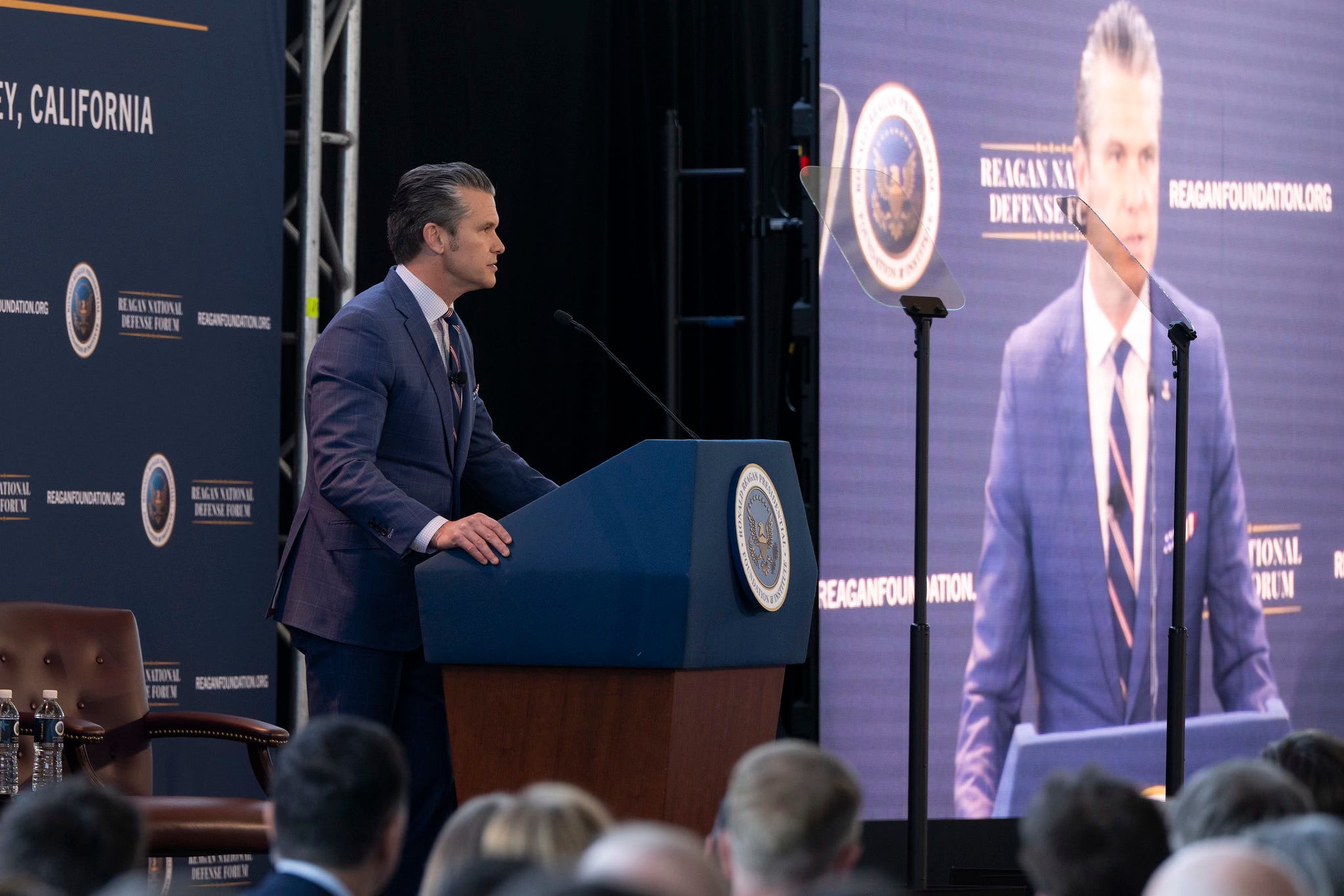
Last December, Secretary Pete Hegseth traveled to the Reagan Presidential Library to lay out the new National Defense Strategy. He touted the Iran strikes against the nuclear program as a “textbook example” of the Weinberger Doctrine and recited it as his guide to future uses of force.
But is it? In my latest “From Across the Pond” column for Politico Europe, I argue the Iran War fails every test.
Does Operation Epic Fury also hold up against Weinberger’s tenets? Hegseth would surely have a tough time making that case — and for Trump, this could finally mean trouble.
In a November 1984 speech, then-Defense Secretary Caspar Weinberger outlined six principles for military engagement that were, in many ways, drawn from lessons learned during that year’s disastrous Lebanon expedition and the failures in Vietnam a decade before. Unsurprisingly, Trump’s Iran war fails to meet virtually every single one.
First, Weinberger said, force should only be used if a vital national interest is at stake. And while Iran may be governed by an odious regime that has accumulated a vast arsenal of ballistic missiles, pursued a nuclear program and exported terrorism overseas, the U.S. has lived with this very regime for almost half a century.
Moreover, Tehran is weaker today than it has been in decades. Its economy is in shambles, its proxies have been decimated by Israel, and its allies in Syria have been ousted. The list doesn’t end there: Its nuclear program was buried deep underground after last year’s Israeli-U.S. bombing campaign; its missile stockpiles are dwindling; its production facilities are damaged; its air force can’t fly; its army can’t move beyond its borders; and its navy is little more than a coastal fleet.
So while the end of the Iranian regime would be a good thing, it’s hard to make the case that, weakened as it was by war, sanctions and mismanagement, Tehran posed enough of a threat to vital U.S. national interests to justify a preventive war.
Read the entire piece in Politico Europe.
The only thing these people think about really hard is how it will look on tv during the next 48 hours. They are bored by everything else.