

The Rise of Impunity
The fourth edition of the Atlas of Impunity raises profound questions about the global order.

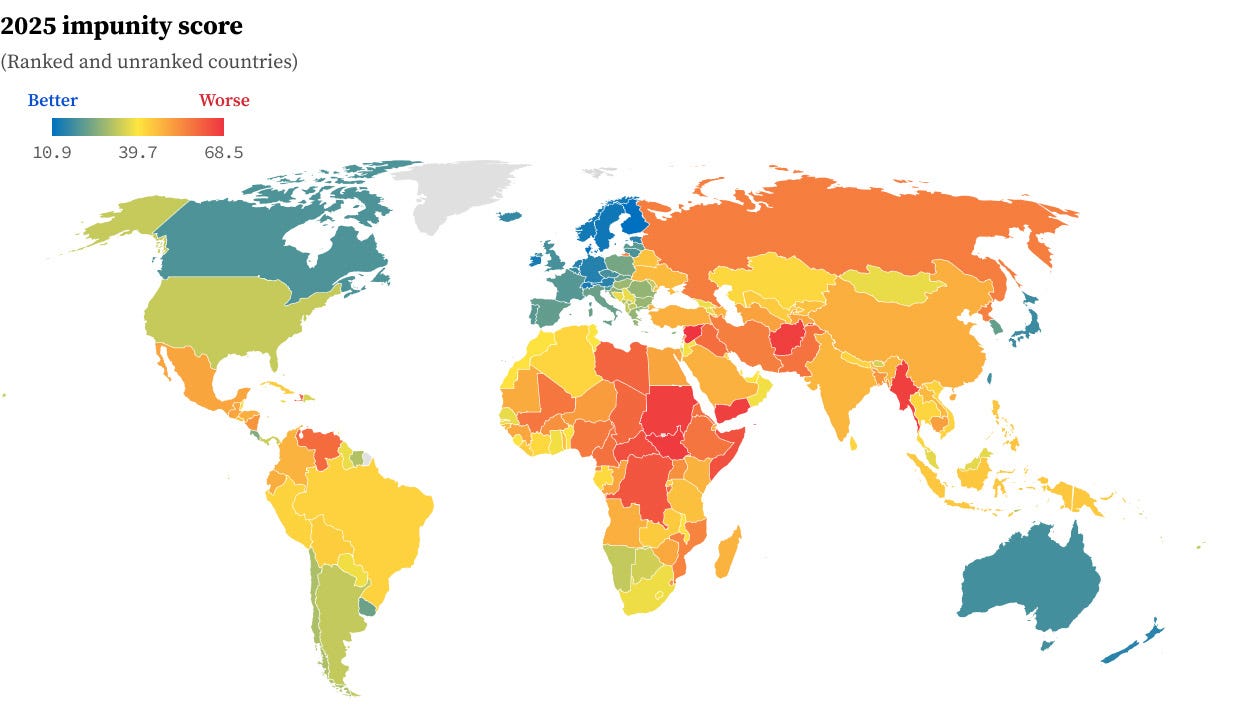
The prevailing view in foreign policy circles is that the erosion of the international rules-based order is a uniform, global trend affecting every country at a similar pace. But according to the newly released fourth edition of the Atlas of Impunity—a massive data project by Eurasia Group and David Miliband with which I have been associated from the start—that mental model is wrong.
By tracking 60 accountability metrics across nearly 200 countries, the Atlas demonstrates that global lawlessness isn’t spreading evenly. It is hyper-concentrating.
Looking strictly at the macro data, the global average impunity score has sat virtually unchanged since 2020. But that statistical flatline hides what the report calls the “Great Divergence” — with middle-tier nations incrementally tightening their legal and institutional guardrails, while a handful of highly repressive, war-torn states are collapsing into total systemic lawlessness. The gap between societies governed by rules and societies governed by raw force is wider today than at any point in recent memory.
The Concentration of Chaos
One way to understand what this divergence looks like in practice, is to look at how modern warfare impacts the data. We tend to think of global conflict as a generalized rise in tension, but the Atlas’s data reveal an extraordinary disparity in how the human cost of violence is experienced:
A staggering 46% of every single organized military battle recorded on earth last year took place within a single country: Ukraine.
31% of all state-perpetrated violent events targeting civilians globally occurred in just one territory: Myanmar.
For the average citizen living in a median-ranked country, daily life has actually seen a post-pandemic cooling of civil unrest. The horror of modern breakdown isn’t everywhere—it is being dumped primarily onto a few high-misery geographies.
Three Crucial Pivot Points
This year’s Atlas is full of interesting data and points. It’s worth reading in full. But let me focus here on three vital conclusions that can be drawn from the report:
Free information is the first domino to fall. We frequently treat threats to press freedom as domestic cultural issues rather than national security crises. The Atlas proves otherwise: institutional decay is the ultimate engine of global impunity, and the choking out of independent media is its primary transmission mechanism. When a regime blinds independent journalists, it doesn’t just silence critics; it destroys the information environment required to detect when rules are being broken in the first place. Dictators are successfully treating information warfare as the prerequisite for total strategic license. But that r.ality isn’t restricted to autocracies alone; increasingly illiberal democracies have learned the lesson as well.
The US has transitioned from the anchor of the rules-based order to its chief volatile wildcard. In a historic shift for this index, the United States has broken away from its rich-country peers to become a primary driver of global impunity. Plummeting six places to 117th in the rankings, the second Trump administration’s “political revolution” has actively normalized the erosion of systemic checks. The real danger here isn’t just domestic overreach; it’s “copycat impunity.” When Washington signals that international law, treaties, and domestic norms are merely optional inconveniences, real and would-be autocrats worldwide treat it as a green light to drop their own constraints.
The structural erasure of USAID is a massive geopolitical unforced error. The most devastating policy decision highlighted in the data is the wholesale dismantling of the US foreign aid networks. Under the banner of the Department of Government Efficiency, the US axed 86% of USAID awards, a $27.7 billion retrenchment that effectively shuttered the agency. This wasn’t about cutting fat. It systematically liquidated the global network of local anti-corruption watchdogs, legal aid agencies, independent media outlets, democracy promoting groups, public health efforts, and more that help battle impunity. By dismantling this accountability infrastructure, Washington didn’t save money—it left a massive institutional vacuum that America’s geopolitical adversaries are already moving to exploit.