

No Process, No Peace
The New York Times dives deep into the Trump Administration's failure to secure an end to the war in Ukraine. It's a damning piece of reporting, demonstrating the lack of process is partly to blame.

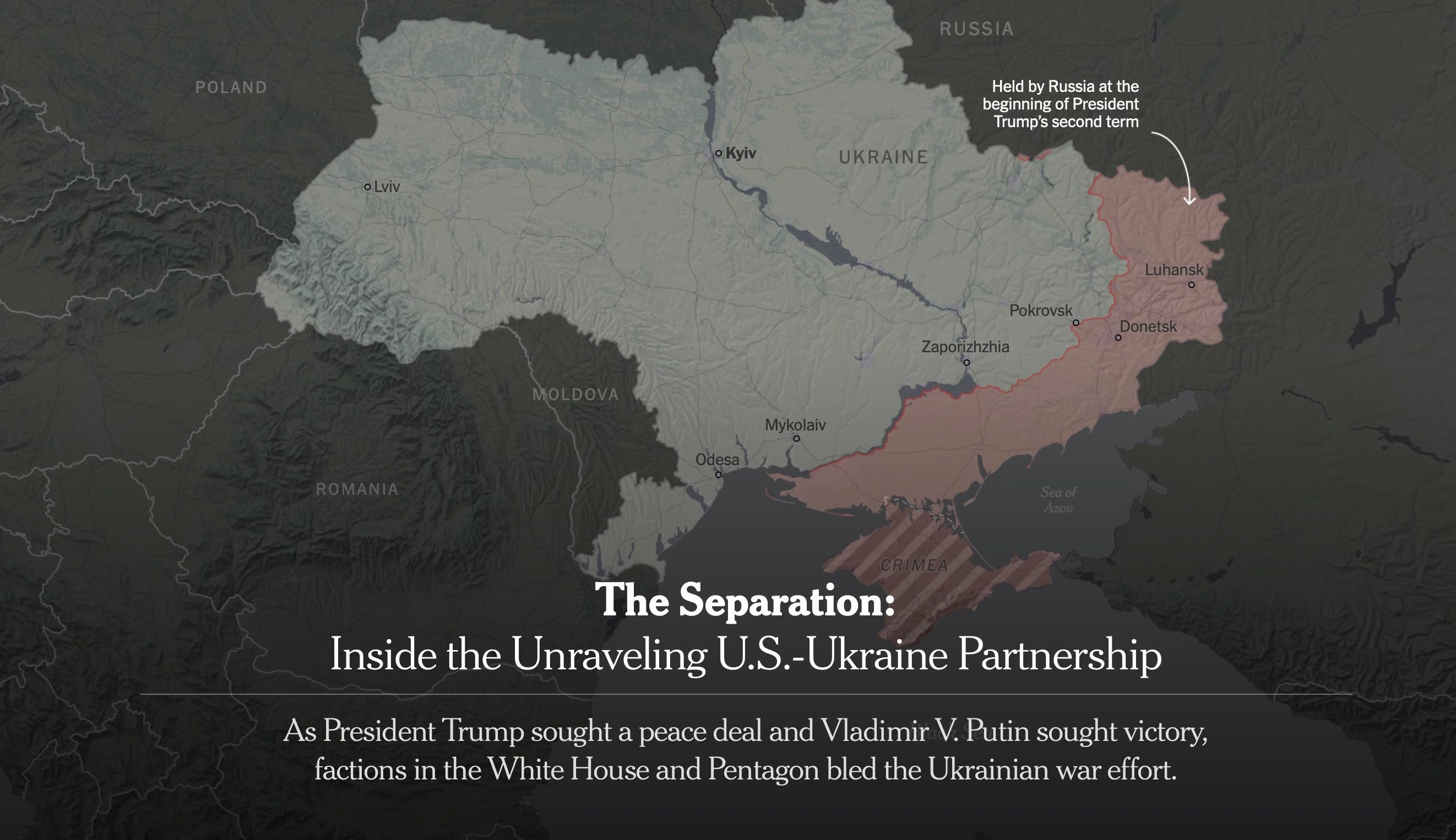
“A good process does not guarantee a good outcome, but a bad process virtually guarantees a bad outcome.” I was reminded of this aphorism, often attributed to Dwight D. Eisenhower, when reading the extraordinary reporting on the unraveling of the US-Ukraine relationship by Adam Entous in the New York Times this morning.
The piece is chock full of extraordinary revelations resulting from 300-plus interviews Entous conducted over the past 12 months. The “head spinning” revelations include:
The Ukraine specialists at the Pentagon afraid to utter the word “Ukraine.” Mr. Trump telling his chosen envoy to Russia and Ukraine, “Russia is mine.” The secretary of state quoting from “The Godfather” in negotiations with the Russians. The Ukrainian defense minister pleading with the American defense secretary, “Just be honest with me.” A departing American commander’s “beginning of the end” memo. Mr. Zelensky’s Oval Office phone call, set up by the president, with a former Miss Ukraine.
The Absence of Process
The whole story is a must-read. But for me, a student of how American foreign policy making works, what struck me most was the complete absence of a foreign policy process. In a normal administration, even in one where there are deep differences over policy and the direction of America’s global engagement, there is both a formal and an informal process by which policy is made.
But not in this administration. The entire Ukraine saga, as reported by Entous, is one long story of how the absence of a formal or even informal policy process explains the ups and downs of Trump’s Ukraine policy. The examples are numerous, and they explain a lot:
Before Trump’s inauguration, incoming National Security Advisor Mike Waltz asked the outgoing administration for a letter to authorize early contact with Russia to enable Trump to make good on his promise to end the war “in one day,” possibly even before his inauguration. The Biden administration declined. But when the Saudis told Steve Witkoff, who Trump had appointed as his Middle East envoy and worked closely with the Biden team to help secure a ceasefire in Gaza, that the Russians wanted to talk to him, Trump authorized Witkoff to open a back channel because it would be an informal meeting of “a business guy with a business guy.”
Witkoff’s appointment as a back channel was a surprise to Keith Kellogg, who Trump had originally appointed as his Special Envoy for Ukraine and Russia. The Russian portion of his portfolio was short-lived. In their first Oval Office meeting to discuss the peace initiative, Trump pointedly told Kellogg “Russia is mine.” Witkoff, meanwhile, decided that he didn’t need a notetaker when he met with Vladimir Putin (and even relied on the Russian President’s translator for their first meeting). “I’m a trained lawyer,” Witkoff explained. “I was the note taker.” Another process foul.
Meanwhile, a small coterie of aides in the Pentagon worked to convince Secretary of Defense Pete Hegseth that the continued supply of weapons to Ukraine, including those authorized by the Biden administration and funded by Congress, risked shortfalls in US stocks necessary for war plans and other contingencies. There was a constant effort on the part of these aides to halt, obstruct, slow down, and interfere in the shipment of weapons. Trump had only himself to blame, because he had given Hegseth carte blanche: “Pete, you’re doing a great job, and you just go ahead and you don’t need me to make decisions.” So Hegseth thought he could stop shipments, only to be later overruled by Trump when someone else convinced the President Ukraine needed the weapons. The lack of process was again at fault. There is no record of a sit-down in the White House Situation Room of key players to decide what Ukraine needed, what the US could provide, how Europeans and others might fill the gap. It was all made-up on the go.
Even as the Pentagon was doing its utmost to prevent weapons from flowing to Ukraine, the CIA was doing its best to help Ukraine militarily. Its officers had long been present in Ukraine, helping steer intelligence about Russian activities and new targeting data to their Ukrainian counterparts. When Ukraine started to use its longer range drones to hit Russian refineries, the CIA helped them identify key components that were difficult to replace and could keep these refineries off line for weeks if they were targeted successfully. Trump supported the CIA in these efforts. So while one part of the administration was seeking to undermine Ukraine’s ability to defend itself by cutting weapons supplies, another sought to help Ukraine by weakening Russia’s ability to sustain the war—both with Trump’s support!
The entire diplomatic effort has been chaotic because there is no process that backstops the negotiations. In any other administration, a formal negotiating effort would be informed by intense interagency discussions to help arrive at agreed positions to be put forward by negotiators at the table. Not in this case. Witkoff has spent hours talking to Putin, who as the wily KGB agent that he has always been, found him an easy mark. (Indeed, as the Wall Street Journal reported, it was the Russians who planted the idea of having Witkoff in the lead.) And since October, Witkoff and Jared Kushner have worked together to draw up a multi-point plan to end the war with Ukraine that cannot be the basis for an agreement between Russia and Ukraine for the simple reason that there aren’t any points the two sides can agree upon. A sound policy process would have considered the points of leverage that need to be exerted to get the parties to the table and, ultimately, to an agreement. But there is no process, and the one person who has long thought about these issues in these terms—Keith Kellogg—has been excluded from any discussion and will now step down.
No One to Blame, But the President
“Presidents get the national security process they deserve.” This statement, by former National Security Advisor Stephen Hadley, sums up the Entous story as well as anything can. In the end, the absence of a formal policy process is exactly what Donald Trump wants. The only process he seeks is to be in command. He makes the decisions. His word is final. Even if he changes his mind.
“Russia is mine” sort of says it all. At the core of Trump’s belief is that he has a personal relationship with Vladimir Putin that he can use to end the war and bring peace. What Trump didn’t count on—what Putin still doesn’t get—is that the people of Ukraine have another idea. They want to be free, to be sovereign and independent. They want their territory back. They want to be part of the West—members of both NATO and the European Union. And they are willing to fight for all these wants, even at extraordinary costs.
There is no guarantee, as Eisenhower said, that a good process would have led to a better outcome. But it’s clear that when you don’t have a process, and when you firmly believe that you alone can fix anything and everything, the outcome is going to be disappointing.
I want combat duty pay for reading that full NY Times piece. Some may find it insightful. I found it painful. It confirms over and over how destructive the most influential players are in the Trump team. Hegseth and Vance are villains from central casting. Reading of all that harm to Ukraine is like a bludgeoning.
My take-away is that Europe needs to break with this toxic crew. I don't get the sense that they dare. But its all on Europe now.
The mystery is how Ukraine survived this year of American betrayal without even worse setbacks.
.
Outstanding recap to an outstanding piece of investigative journalism. Witkoff has been Putin’s useful idiot from Day 1 and the lunacy of winging foreign policy - or rather just waiting for Trump to dribble out a sentence- is madness.
But it’s true globally, certainly with China and A-P, Africa and the ME, no process, just whatever Trump says or blurts. That NSS seems to be yesterday’s news now, but all Trump wants is his backyard under his thumb-and the MAGA fissure (Make America First Again) is gaining strength.
It’ll be quite a year, Ivo..😱