


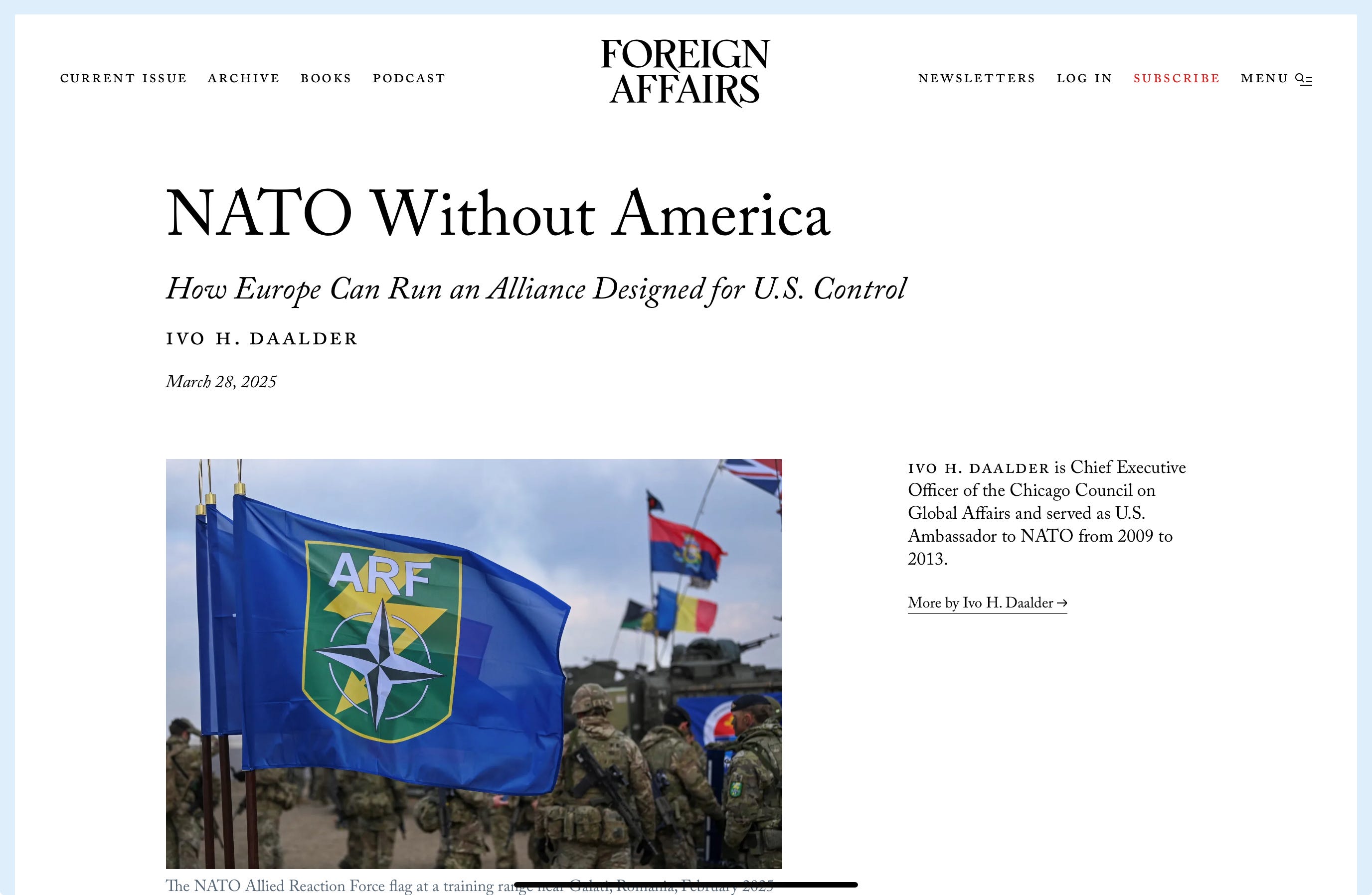
This Friday, NATO members will mark the 76th anniversary of the signing of the North Atlantic Treaty in Washingon, DC. Not a few will likely wonder whether this is the final year they will celebrate an alliance that has secured peace on the long-wartorn European continent for more than three-quarters of a century.
NATO has witnessed many crises in hits long history, but for the first time it is facing an existential crisis. Never before has there been as profound an agreement on the threat that NATO seeks to deter and defend against. And never before has a member—let alone its principal security provider—cast doubt on the idea that its security is inextricably bound up with the security of the other members.
Until now. The United States joined Russia at the United Nations last month in rejecting a Ukrainian resolution, supported by all other NATO members and many dozens of other nations, calling for the aggressor to withdraw its forces from Ukraine. President Donald Trump has said the US won’t defend those allies who “don’t pay.” And Vice President JD Vance traveled to Munich last month to tell allied leaders that he feared Europe’s “enemy within” far more than Russia.
Europe has taken note. Its leaders have committed not only to beef up their defenses but to sharply reduce, if not eliminate, their reliance on the United States. That is the right response—one they should have taken many years ago. But Europeanizing NATO won’t be easy and certainly not quick. As I argued in a new piece published by Foreign Affairs, it will take three factors that are presently in short supply: money, time, and US cooperation.
I urge you to read the entire argument in the magazine. Here is a gift link to the piece.