

Iran’s Nuclear Stockpile — Reality vs What Could Have Been
President Trump will end the war with Iran once Tehran agrees not to possess nuclear weapons. That’s the situation that existed when Trump first became president. And then he threw it away.

President Donald Trump told the PBS NewsHour recently:
No nuclear weapons. Very simple. Iran cannot have a nuclear weapon. Very simple… We’re not negotiating anything other than the fact that they will not have a nuclear weapon. And that’s pretty basic when you get right down to it. So you know, that’s it.
Forget, for a moment, that when Trump decided to go to war against Iran nearly three months ago, his goals were far more expansive—including regime change, eliminating its missile stockpile and production capability, and ending support for regional proxies.
Instead, let’s take Trump at his word that the war will end if Iran has no nuclear weapons. But remember that we are in this situation where Iran could have a nuclear weapons as the result of a singular decision—made by a single individual back in 2018. That individual was President Donald J. Trump. And the decision was to withdraw from the 2015 nuclear agreement—the Joint Comprehensive Plan of Action as the deal negotiated under Trump’s predecessor is inelegantly known.
Trump called it “the worst deal ever.” Perhaps. But once Trump withdrew from the agreement, Iran was free to develop its nuclear program in ways it could never have done under the JCPOA. Even once all the restrictions on nuclear enrichment had sunset under the 2015 deal, it would have taken Iran at least until the late 2030s to produce upwards of nine tonnes of enriched, because until 2031–five years from now— Iran’s total enriched stockpile was limited to 300kg.
Why it Matters
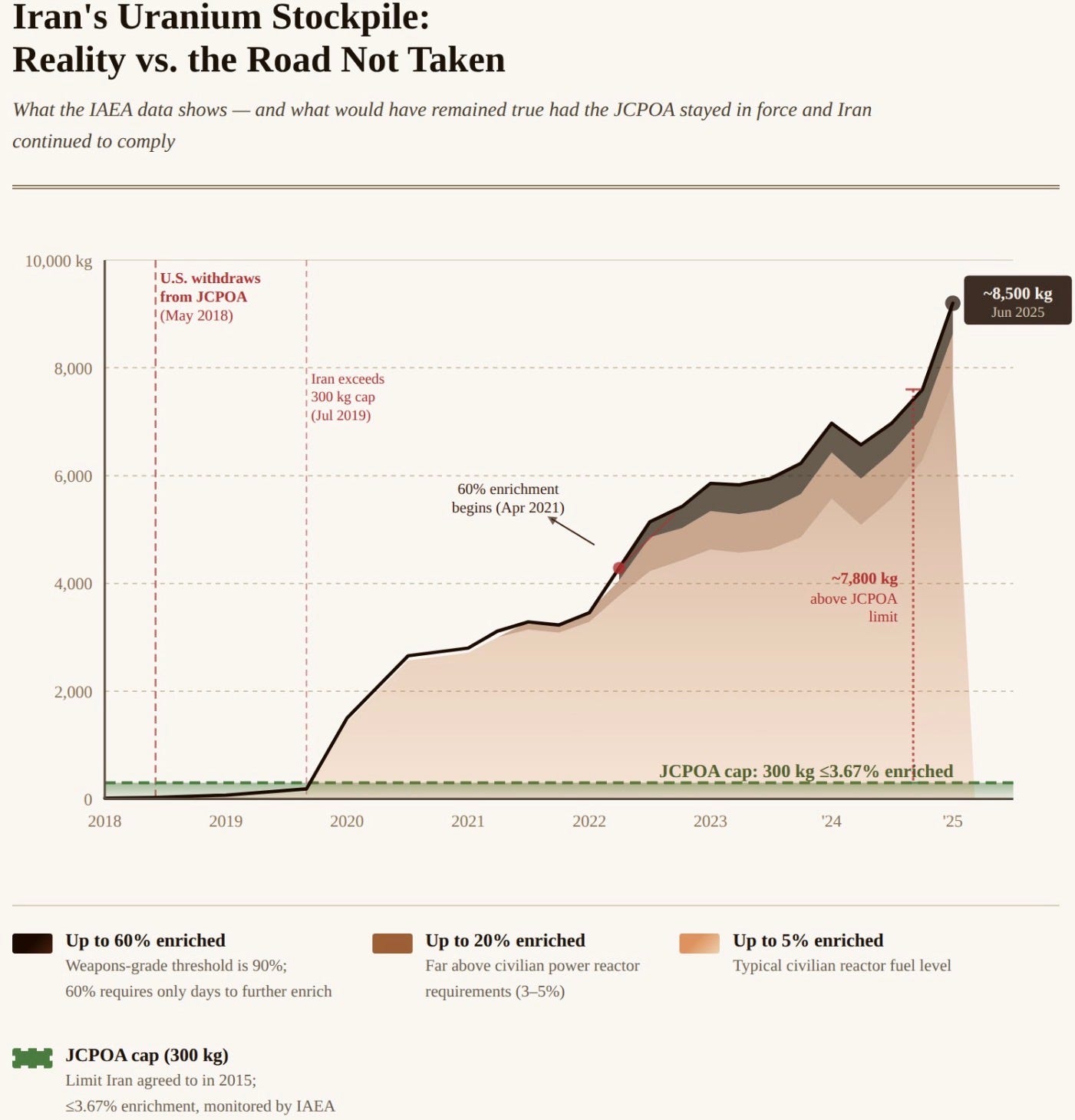
Here’s why this matters. If the JCPOA had remained in force, Iran today would have had a stockpile of 300kg (660 lbs) of uranium enriched up to the maximum of 3.67%, sufficient to fuel a single research reactor. Advanced centrifuges would only have started to operate this year—not in 2018, when Trump withdrew from the agreement. And enrichment above 3.67% would not have been allowed until five years from now, in 2031.
In other words, Iran got a 8-13 year head start on enriching uranium because Trump withdrew from the 2015 nuclear agreement. And that assumes that worst the JCPOA in force, Iran would have immediately accelerated enrichment after it expired and that nothing in the intervening years would have brought a more permanent resolution to its nuclear ambitions.
To understand the gravity of the situation, I asked me friend Claude to graph the evolution of the Iranian nuclear stockpile since Trump withdrew from what he called “a horrible, one-sided deal” compared to the level of enrichment allowed under that deal up to the present. (See above.)
Instead of 300kg of low-level enriched uranium, Iran today has about 8,500kg today—including 440kg of uranium enriched to 60% and another 220kg enriched to 20%. The 60% stocks alone would be sufficient for about 11 nuclear weapons if enriched somewhat further, which could be done in a matter of days.
While weapons designers would prefer to work with uranium enriched up to the weapons-grade level of 93%, with sufficient quantities it is possible to build nuclear devices with the existing stocks of enriched uranium. Those would either be significantly larger (and therefore wouldn’t fit on top of a missile) or have an explosive yield that was significantly smaller (though still devastating).
Moreover, if Iran were able to further enrich not only the 60% enriched stockpile, but the 20%, and even lower enriched stockpiles, the total amount of enriched uranium that exists in Iran today would be sufficient to produce perhaps as many as 100 nuclear weapons. Compared to none—zero weapons—the day Donald Trump decided to withdraw from the Iran nuclear deal concluded in 2015.
Truly the Worst Deal Ever
In other words, the material Iran already possesses is the key to its nuclear weapons capabilities. And the amount it possesses today is almost 30 times larger, and far more enriched, than if Trump had stuck with the original deal.
The JCPOA may not have been perfect. But walking away from it without a strategy to replace it with something better has landed us in the mess we are now in.
That’s what I’d call: The Truly Worst Deal Ever.
The reality of Trump’s JCPOA withdrawal should be hammered daily. It‘s the most irresponsible action he took in his first term — with disastrous consequences now…for the entire world. We need to make sure that the consequences also affect him: with a Democratic House and Senate that will hold him accountable for this and all his other egregious actions as well as enact laws to prevent these things from happening again.