

Has Trump Turned on Putin?
While clearly annoyed that Putin is unwilling to end a war Trump thinks never should have happened, real pressure on Russia by way of more sanctions and more military aid is unlikely.

Donald Trump is pissed off.
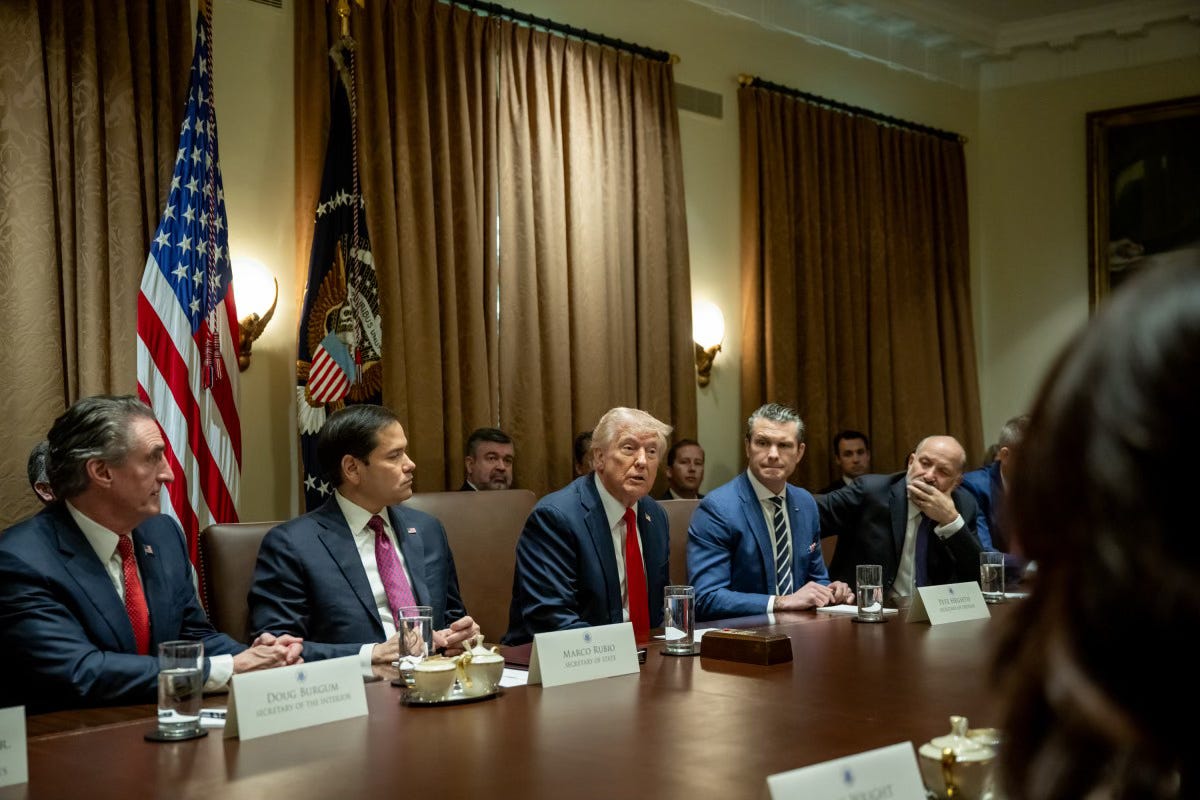
“I’m not happy with him,” Trump said of Vladimir Putin after his sixth call with the Russian president in five month. “He’s killing a lot of people.” A day later, Trump told his cabinet that “we get a lot of bullshit thrown at us by Putin,” marveling that “he’s very nice all the time, but it turns out to be meaningless.”
That’s clearly a change in attitude. For years, Trump has admired Putin as a “strong leader.” He called him “savvy,” “smart,” and a “genius” for having started a full-scale invasion of Ukraine. He blamed Joe Biden and NATO for provoking a war that “would have never happened if I had been president.” And during last year’s campaign he repeatedly promised that he would end the war “in 24 hours,” even before he was inaugurated.
But that was then. Now Trump is angry. Putin, to apparent Trump’s surprise, isn’t interested in ending the war—at least not on terms that are acceptable to Ukraine, to the Europeans, or perhaps even to Trump himself. Putin won’t take the deal Trump offered him—a deal that would have Ukraine ceding territory of the four provinces Russia illegally annexed in 2022, the US offering to recognized Crimea as Russia, and Washington permanently vetoing Ukrainian membership in NATO. No, Putin wants it all. All of Ukraine, and more.
Trump may finally have come to accept this reality—though anyone who has spent any time even cursorily looking at the war would have known that Putin wasn’t interested in peace and an end to the war wasn’t going to come quickly.
Trump’s volte face has given many people hope that he will now put the pressure on Russia. Though the White House agreed with a Pentagon request last week immediately to stop planned weapons shipments to Ukraine (including those already in Poland), Trump reversed course after speaking with President Zelensky on Friday. Acknowledging that “they have to be able to defend themselves,” Trump promised “to see if we can make some available,” referring to Patriot interceptors. But “they are very hard to get,” he quickly added. “We need them, too.”
Trump also appeared more open to a tough sanctions bill that has been pulled together by a bipartisan group of Senators, including his golfing buddy, Senator Lindsay Graham. The Senate bill, which has more than 80 cosponsors, would strengthen enforcement on existing sanctions, bar shipments of energy-related goods, and, most importantly, raise tariffs by 500 percent on any country that imported oil, gas, uranium, petroleum, and petrochemicals from Russia—a huge threat to China and India, and also to some key US allies, like Japan and Hungary.
Republican leaders in the House and Senate have indicated that they could move swiftly to approve the bill, even before the summer recess kicks in at the end of the month. If passed, and signed, that would be a very big deal—increasing the pressure on Russia and those that have directly and indirectly supported it very substantially,
But there is a catch — or, actually, a potentially giant loophole. In announcing Trump’s possible support for his bill, Graham indicated that he was modifying some key parts of the bill, notably to give the president more leeway on deciding when and how to impose or lift sanctions. “It's an optional bill. It's totally at my option,” Trump indicated. Sanctions would be imposed “totally at my option and to terminate totally at my option.”
So, weapons shipments to Ukraine can be turned off and on—totally at Trump’s option. And sanctions can be imposed and lifted—totally at Trump’s option. Of course, all presidents want to have the flexibility and control to decide foreign policy; none want to be subject to congressional fiat. So Trump’s desires on this score are hardly unique.
But Trump’s record on Ukraine is reason for caution. He’s overestimated how easy it is to end the war. (“A half-baked negotiator could have settled this years ago,” he claimed in April.) He wrongly blamed the US, NATO, and Ukraine for the war—and has only reluctantly and much-belatedly come around to accepting that Russia may have something to do with it. He still ignores the underlying political causes of the war, blaming the “killing” and “bloodbath” on both sides equally. "Sometimes you see two young children fighting in the park,” he explained last month. “Sometimes you're better off letting them fight more before you pull them apart.”
And that’s the real reason to be skeptical about suggestions that Trump now “gets it” and will do what he should have done all along: firmly side with Ukraine, the war’s victim, by sending it as much military, intelligence, and other support as possible, and firmly oppose Russia to make clear to Putin that the United States and its allies will stay in the fight for as long as it takes for him to understand he can and will not win.
Trump sees this war as unnecessary and a tragedy. A tragedy it is. But this war—like all wars—is an expression of real, deep-seated conflicts. “War,” the German general Carl von Clausewitz famously said, “is the continuation of politics by other means.” Wars end when the politics driving them change. Outside actors can influence these politics—by punishing one side and helping another. But they don’t change—and wars don’t end — just because Donald Trump or someone else wants to or says so.
So, I’m not holding my breadth in the hope or expectation that Trump suddenly understands this. He may be angry at Putin. But he has no desire to make this wrong his own.
Trump agrees with Putin
Probably not.
https://trypilla.substack.com/p/there-is-no-pivot-there-is-a-pattern