

From Peacemaker to Warmonger
Donald Trump campaigned on being a peacemaker but has spent the better part of a year becoming a warmonger--striking seven countries, most without much rhyme or reason.

“We will measure our success not only by the battles we win but also by the wars that we end — and perhaps most importantly, the wars we never get into,” President Donald J. Trump said in his second inaugural. ”My proudest legacy will be that of a peacemaker,” he continued. “That’s what I want to be: a peacemaker.”
For much of his first year in office, Trump talked a lot about being the Peacemaker-in-Chief, repeatedly claiming credit for ending wars he neither ended nor resolved. His singular goal was global recognition and the Nobel Peace Prize that he thought he so richly deserved.
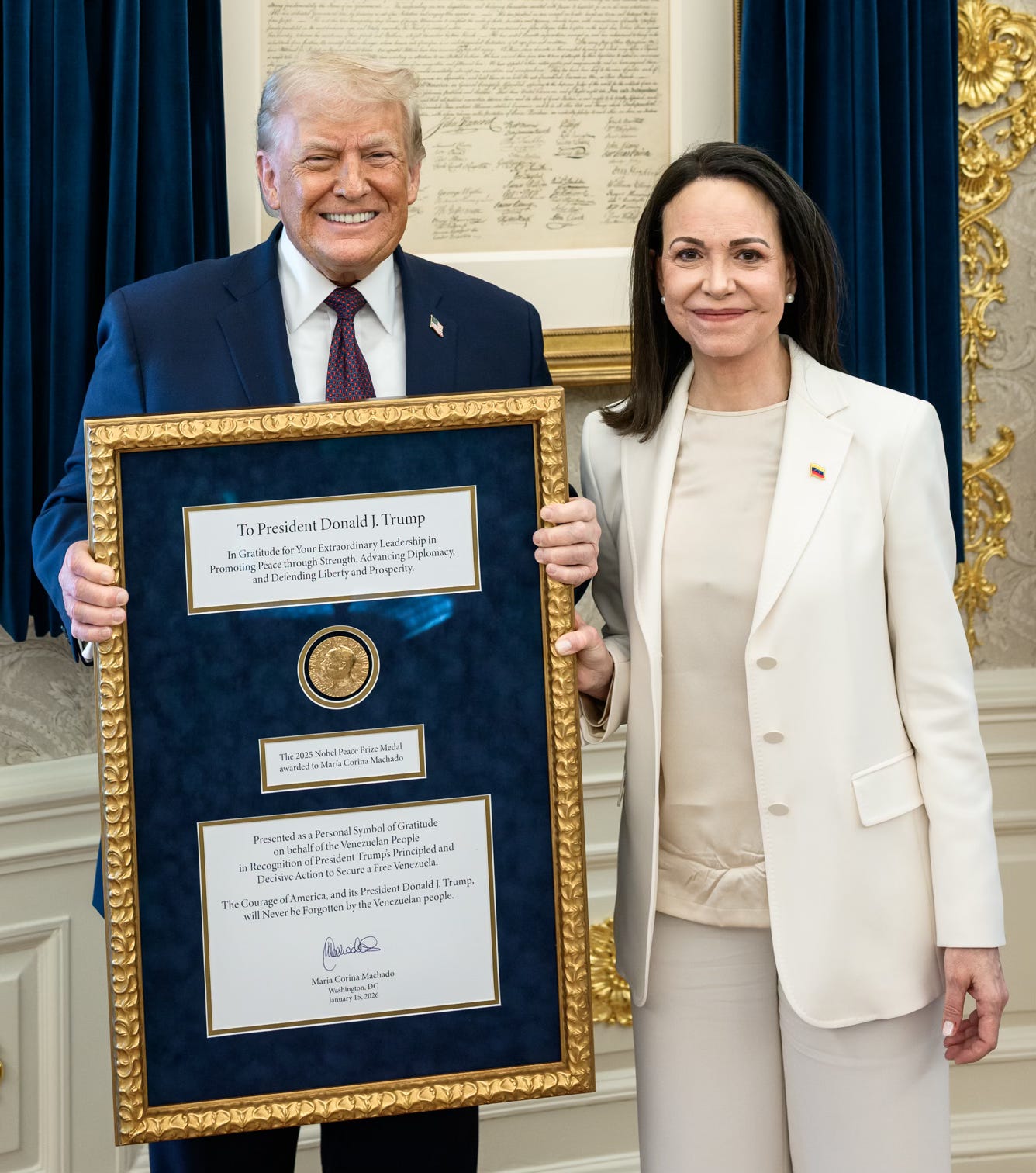
The Nobel committee didn’t agree. So Trump had to settle for a hand-me-down Nobel Prize and a FIFA Peace Prize that the president of the world’s football association designed to ingratiate himself with the man in the White House.
But apparently these ersatz peace prizes have satisfied his appetite for global recognition, for Trump has now firmly abandoned any effort to be the peacemaker and has instead become the Warmonger-in-Chief.
Three Wars in Two Months
In two months, he has launched air and missile strikes against three countries on three continents—all unprovoked, all unnecessary, all illegal, and all likely failures.
On Christmas Evening, the president authorized strikes against Nigeria, ostensibly against Islamist forces massacring Christians, though the country is beset by widespread violence against Muslims and Christians alike and the targets hit had little if anything to do with the violence.
On January 3, the president ordered a massive military raid on Venezuela to seize and arrest its President Nicolás Maduro and his wife on drug charges. While Marco Rubio, justified the use of military force as a law-enforcement action, Trump made clear that his real goal was to “run the country” and seize its oil.
Now, on February 28, the president has embarked on his most audacious—and fraught—use of force by attacking Iran. Its goal appears to be nothing less than the end of the Iranian regime.
In justifying the strikes, Trump harkened back to start of the Islamic Revolution, the detention of dozens of Americans for 444 days, the attack on the Marine barracks in Beirut in 1998, and the bombing of the USS Cole in 2000. All of these were heinous acts. But they hardly justify launching a major war in 2026.
Why Now?
So why now? Trump said that the “objective is to defend the American people by eliminating imminent threats from the Iranian regime.” The Iranian regime is many things—evil, dictatorial, murderous, even dangerous. But it’s hardly an “imminent threat” justifying preventive war.
In fact, the Iranian regime is widely seen as being at its weakest since the end of its war with Iraq in the late 1980s—or even since the revolution. Its economy is in shambles due to decades of sanctions and mismanagement. Its proxies have been decimated by Israel in two years of unrelenting war. Its allies in Syria and elsewhere have been ousted. Its nuclear program is buried deep underground by the June 2025 Israeli-US bombing campaign, and set back for a year or more (if not quite “obliterated” as Trump has continued to claim). Its missile stockpiles have dwindled and its production facilities have been damaged. Its Air Force cannot fly, its Army cannot move beyond its borders, and its Navy is little more than a coastal fleet.
So, is Iran a threat? To its own people, for sure. To its neighbors, perhaps. Though those neighbors have overwhelming capacity to strike back. To oil shipments from the Gulf? Yes, if provoked to close off the Straits of Hormuz? To Israel, less than before but possibly in the long run. But to the United States? And imminently? Hardly.
President Trump has set America on an irreversible course to another Middle East war. From Lebanon in the 1980s, to Iraq in the 1990s and again in the 2000s, American wars in the Middle East don’t tend to end well. This one won’t either. The Iranian regime will suffer. Its leaders may even be killed. Its military is no match for the United States. But starting a war is a lot easier than ending it. And achieving lasting stability through the use of force alone never succeeds.
The People will Pay
Ultimately, it will be the Iranian people who will pay the biggest price. Last year’s attack on Iran’s nuclear program didn’t free the people from their regime. When hundreds of thousands went onto the streets to protest their plight, Trump declared that “help is on the way.” Tens of thousands were killed, wounded, and jailed as a result.
Now, the American president has again called on the Iranian people to rise up “Bombs will be dropping everywhere. When we are finished, take over your government. It will be yours to take.” If only it were that easy. Remember George H.W. Bush calling on the Iraqi people to rise up and oust Saddam Hussein during the Gulf War? They did, and the US stood by as Saddam’s security forces slaughtered them in huge numbers.
This time around, the US has deployed air and naval power in huge numbers—but no ground forces. So when Trump tells the Iranian military, revolutionary guard, and police to lay down their arms or “face certain death,” everyone knows that is bluster, not backed by force.
Like Trump’s decision to bomb the Houthis a year ago—and his strikes against Nigeria and Venezuela two months ago—the attack on Iran is a war of choice. Unnecessary. And very likely unsuccessful. As in the case of the Houthi strikes, Trump will likely soon tire of the war and declare victory. But this time he will leave a country and a region in chaos and ruins. That’s not a recipe for long-term stability, let alone for peace. It’s a recipe for unending conflict and war.
That’s what happens when you abandon peace for war. And the world will have no one to blame other than the man who needlessly started it all.
Somebody give that nepo baby a soother to shut him up! He's keeping us all awake night after night. I bet if Mohammed Ali was alive he'd make him give him his world title belt and prance around on stage singing "float like a butterfly, sting like a bee." This guy is a radicalised terrorist and "the enemy within."
Zelensky has made comments this morning which seem to support Trump's actions, noting Iran's supply of drones to Russia.
What do you make of that?
Is Zelensky trying to stay in Trump's good graces?