

From bad to worse: Former US ambassador draws grim conclusion about NATO
Below is the English translation of an interview I did with the Danish newspaper “Politiken.”

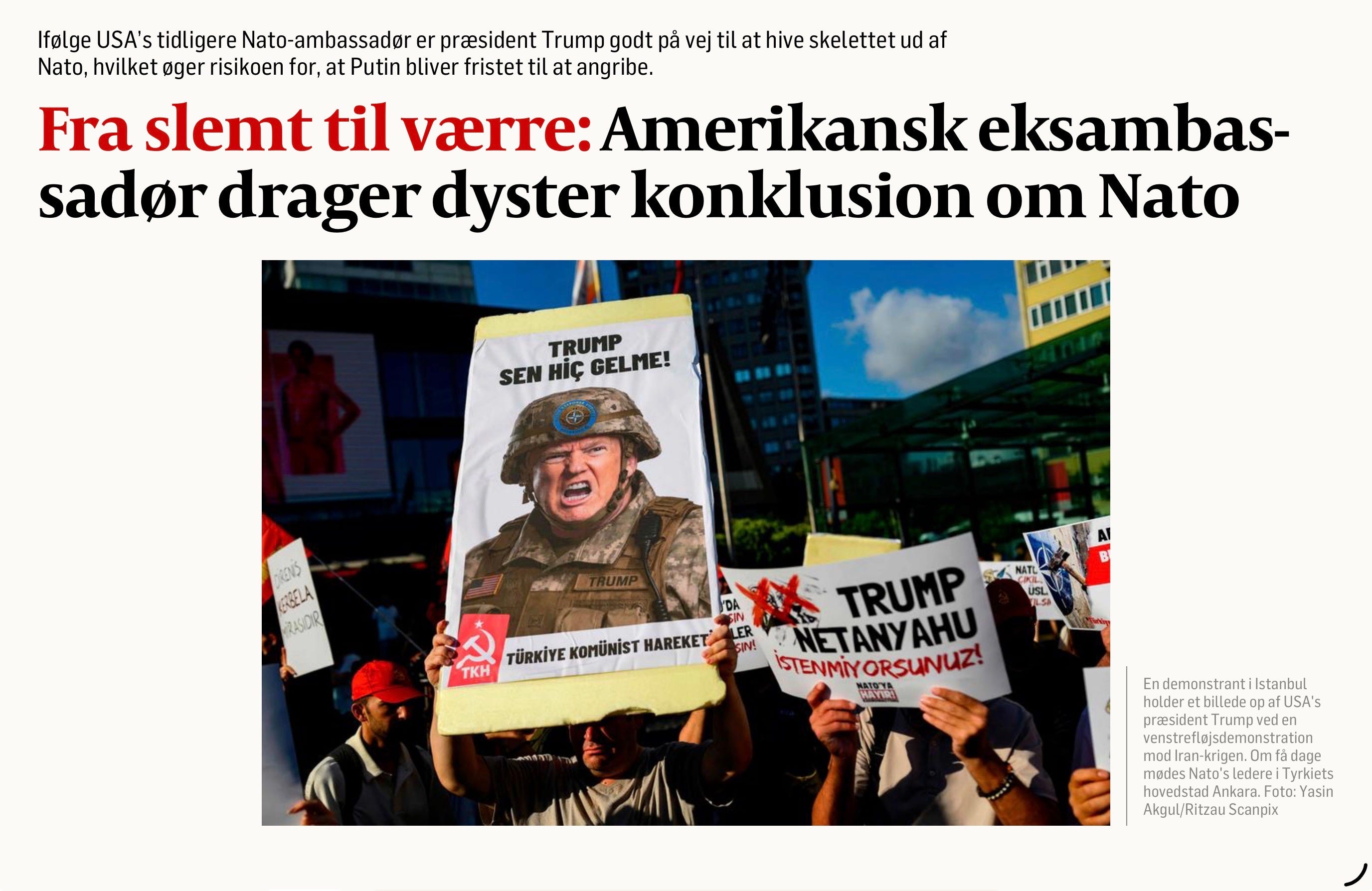
Last week, it had the pleasure to talk with Jakob Hvide Beim, defense editor, and Karin Axelsson, EU correspondent for the leading Danish daily Politiken. Below is an English translation of their story. The original version is accessible here.
Ivo Daalder ends his diagnosis with a dry, resigned laugh.
After last year’s summit in The Hague, the former US ambassador to NATO noted that the alliance, despite challenges, survived “another day.” Many Europeans cringed when Secretary General Mark Rutte set new standards for flattery by calling Donald Trump “daddy.” But there was great relief when the American reciprocated the warm welcome and a European pledge of more defense spending by declaring his support for the alliance.
A year later, Europeans face a new, nerve-wracking summit with the American president in Ankara. And Ivo Daalder’s peculiar laugh is because the situation this time is even worse than ahead of last year’s summit.
“I believe the alliance is currently in the biggest crisis it has ever faced in its 77-year history,” he says.
In January, the crisis over Greenland grew when Trump, after using military force in a swift attack on Venezuela, also escalated threats to take control of the world’s largest island. And when the US, together with Israel, decided to attack Iran, Europe and NATO weren’t even given advance warning.
“Europeans have now understood that the US no longer sees Europe’s security as being as fundamental as its own, which is the whole basic premise of NATO. That’s clear now, especially after the Greenland crisis. And the Iran war has, in my view, become a kind of symbol of the crisis NATO is in.”
“The Iran war has shown that allies no longer see the US as a reliable partner, and that they’re willing to oppose the US in a way that was different just a year ago—and completely unthinkable ten years ago. So the crisis is deep, it’s real. I don’t think it will explode in Ankara, though I wouldn’t be entirely surprised if it did anyway,” says Ivo Daalder.
In particular, Spain, Italy, the UK, and to some extent France and Poland refused the Americans’ request to use their bases and airspace for the war. However, most attention went to German Chancellor Friedrich Merz, who publicly suggested the Iranian clerical regime had run circles around the Americans. Speaking to a group of young people, he even said he wouldn’t encourage his own children to go to the US to study or travel.
“The Iran war has shown that allies no longer see the US as a reliable partner, and that they’re willing to oppose the US in a way that was different just a year ago—and completely unthinkable ten years ago. So the crisis is deep, it’s real. I don’t think it will explode in Ankara, though I wouldn’t be entirely surprised if it did anyway,” says Ivo Daalder.
The US is a weaker military power as a result of the decision to go to war with Iran
The former top diplomat is especially concerned that the rift now runs far deeper than President Trump’s unorthodox approach to geopolitics and his ministers’ verbal attacks on Europe.
“Because it leads to decisions among European countries and in the US that increase the divide. We’re now seeing an incentive for European countries not just to reduce dependence, but to eliminate dependence on the US in a whole range of areas—from production of military capabilities and procurement programs to digital sovereignty. Once you go down that road, it’s very hard to reverse.”
At the same time, the US administration plans to spend $1.5 trillion on defense in 2027, a 42 percent increase over this year, meaning production lines will be occupied with supplying the US, which itself needs to restock after the war against Iran. This pushes Europe far back in line in cases where countries still want to buy American hardware.
“We see it with the Patriot missile system. We see it across a range of systems. The US is a weaker military power as a result of the decision to go to war with Iran—not just geopolitically, but militarily weaker too. So the US will focus on rebuilding its own military for a long time to come,” says Ivo Daalder.
He acknowledges this could further accelerate the trend of Europe standing more on its own feet, which has long been a goal. But it also weakens the ties between the two sides of the NATO alliance.
“And it gives those who want to reduce US engagement in Europe an even bigger reason not to get involved,” says Ivo Daalder.
The US is the skeleton
In Ankara on Tuesday and Wednesday, leaders will discuss the next steps in the Europeanization of NATO, which is already well underway. This isn’t just about Europe contributing more to financing the military alliance’s defense spending, but also taking on greater responsibility for the territorial defense of Europe.
Ivo Daalder isn’t worried about this development. As NATO ambassador, he himself helped push for it. He calls the shift of responsibility toward Europe important, because the US has its eyes on China and key areas of the Pacific. But the problem is that the handover of responsibility isn’t happening in an orderly fashion. Quite the opposite.
The problem is that the NATO framework is now dominated by an administration that no longer believes in NATO
Instead, it’s happening chaotically, under an unpredictable American administration. Following criticism from the German chancellor, Donald Trump has made clear, in an act of retaliation, that he will withdraw 5,000 American troops from Germany. More importantly, he will cancel a planned deployment of long-range missiles—a gap in Europe’s defenses.
“The problem is that the NATO framework is now dominated by an administration that no longer believes in NATO.”
Additionally, the US made clear last month that it intends to sharply cut the number of fighter jets, submarines, and other military hardware planned to be part of NATO’s joint defense in the event of war. Here too, the problem, according to Ivo Daalder, is that this so-called burden-shifting is happening without thorough coordination with European allies.
“I would like this to happen within a transatlantic framework where the US remains fully engaged in the effort. I would like it to happen in a framework where the US, for example, retains the command and control capabilities that have made NATO as successful a military alliance as it is,” he says.
Ivo Daalder pauses.
“The problem is that the NATO framework is now dominated by an administration that no longer believes in NATO.”
Another pause.
“And under these circumstances, I’m concerned that decisions will be made that strengthen the forces working toward dissolution, rather than the forces for integration.”
Will it end with a European NATO? Or European cooperation outside of NATO?
“I don’t see this leading to anything happening outside NATO. Because it doesn’t exist. It would have to be built from scratch. That takes too long, and honestly, no one wants it outside NATO. So I believe it will happen within NATO. The fundamental question is whether it will happen in cooperation with the US or not.”
Ivo Daalder also has a small jab for Europe. Because Europeans have also ignored earlier warnings. Back in June 2011, outgoing Defense Secretary Bob Gates warned, in a kind of farewell speech in Brussels, that it was necessary to invest more in defense, because future US leaders without the same feel for the transatlantic relationship would find it harder to see the point of NATO.
“I believe the US and Europeans made a mistake by not carrying out the Europeanization at a time when there was still willingness in Washington to do it through a cooperative process,” says Ivo Daalder, explaining why it’s now so difficult:
“I usually describe it this way: NATO is an organization whose skeleton and DNA are American. Over time, you can replace that DNA and skeleton and make it more European, but you can’t do it without US cooperation. If you just remove the DNA and rip out the skeleton, there’s nothing left.”
Putin smells blood
Ultimately, all of our security is at stake, because cohesion within NATO—or rather the lack of it—is part of the complex equation that determines Russia’s willingness to attack.
“I fear that Putin sees an opportunity to exploit the disagreements to pursue the goal Russians have had since 1949: to drive the US out of Europe and split the Europeans. The hybrid warfare we’ve seen over the past three to four years, I see as an attempt to weaken European support for Ukraine and split Europeans internally.”
At the moment, Ukraine does have a certain momentum on the battlefield. But a cornered Putin is also dangerous.
“The script that’s been written over the past four years hasn’t developed the way he thought. He’s clearly on the back foot regarding Ukraine. And he has two options: end the conflict before he loses even more, or escalate. And everything we know about Vladimir Putin points to escalation,” says Ivo Daalder.
“The script that’s been written over the past four years hasn’t developed the way he thought. He’s clearly on the back foot regarding Ukraine. And he has two options: end the conflict before he loses even more, or escalate. And everything we know about Vladimir Putin points to escalation,” says Ivo Daalder.
That’s why he considers the risk of nuclear weapon use to be greater than at any point since the 2022 invasion. The same goes for a push into the Baltics to divert attention from Ukraine.
“That’s a concern now widely shared in European intelligence services and in NATO. And I think it’s real. And the divisions that have emerged in the alliance over the past 18 months make this scenario more likely, not less.”
Where would that leave NATO, if Putin attacks us?
“That’s the unanswered question, isn’t it. I would think that the vast majority of European NATO countries plus Canada would react strongly to such a provocation. The fundamental question is whether the US would take part in that. I don’t know. But I don’t see the US trying to undermine a NATO response.”
According to Ivo Daalder, the US’s European Command would likely be in place and functioning, even if American troops as such wouldn’t necessarily take part in a response.
“So I think Putin is misjudging the degree of American commitment to defending Europe’s security. But the problem is that it would be too late once he’s already attacked. Because we don’t want a strong response—we want to prevent a Russian attack in the first place.”
Yes. US skeleton. Dead. Blob Vile. Deceased.